



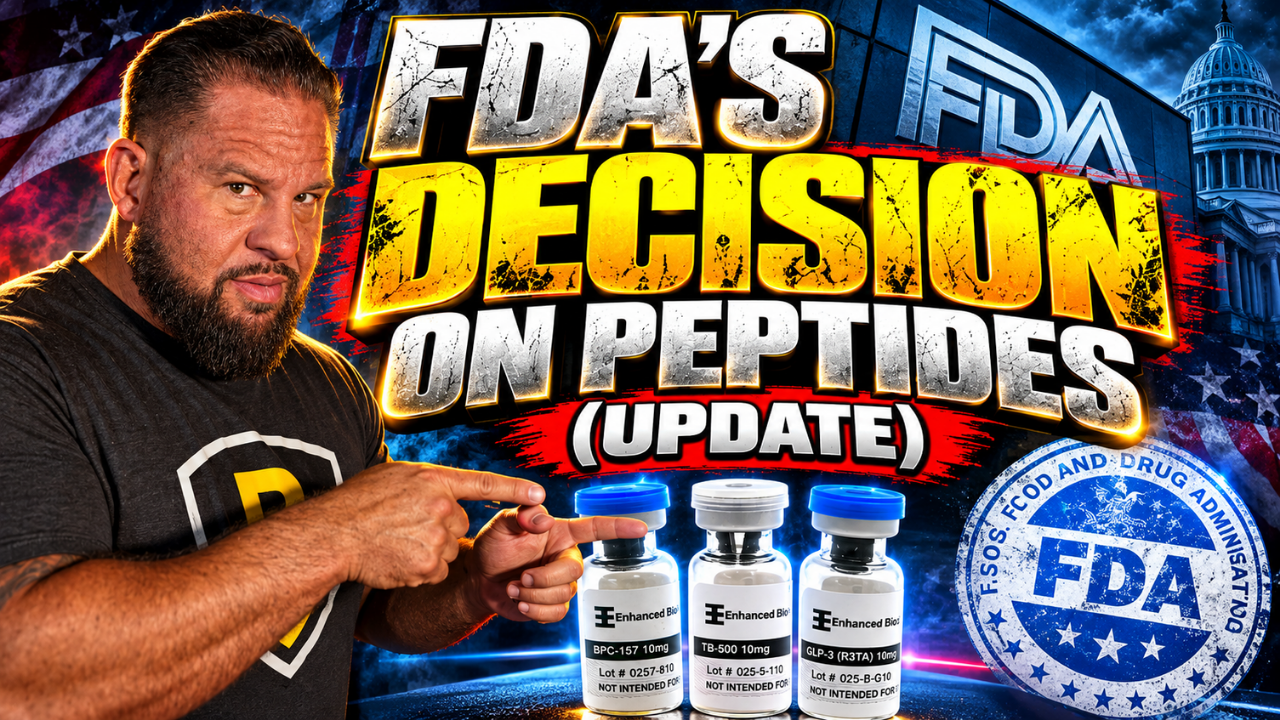
22 Oct FDA Peptide Updates: What’s Really Changing, and Where Do We Go From Here?
Watch the full video on Rumble!
Article Rundown
- FDA Regulations: Recent peptide discussions have created confusion, but regulatory recommendations do not automatically mean legalization or approval.
- Quality and Sourcing: Peptide safety and reliability depend on ingredient purity, manufacturing standards, and proper testing, not simply the country of origin.
- Rising Costs: Increased regulation, medical oversight, and pharmaceutical involvement could make peptide therapies significantly more expensive.
- Future of Peptides: Greater enforcement and industry oversight are likely, but the long-term impact on accessibility, affordability, and legality remains uncertain.
What’s Really Changing, and Where Do We Go From Here?
The peptide industry is getting a lot of attention right now, and depending on who you listen to, you might think the FDA has suddenly opened the floodgates. People are talking about legalization, new opportunities, and easier access to compounds that have spent years in a regulatory gray area. But here’s the problem: People are confusing regulatory discussions with actual changes in the law.
I’ve been following this situation closely, and I want to explain where things stand, what concerns me, and where I believe this industry is heading. While I’m optimistic about the future of peptides, I’m not convinced that increased government involvement will necessarily benefit the people trying to access them.
What Has Actually Changed With the FDA?
In July 2026, the FDA’s Pharmacy Compounding Advisory Committee reviewed several peptides, including BPC-157 and TB-500, for potential inclusion on a list of substances eligible for certain pharmacy compounding exemptions. The committee recommended moving several substances forward, but those recommendations did not automatically make them approved medications or authorize widespread distribution. More recently, the FDA submitted a proposed change to its peptide compounding policy for further review.
Compounds such as BPC-157, TB-500, CJC-1295, and ipamorelin have attracted tremendous interest, particularly among people focused on recovery, performance, and longevity. However, these substances do not have FDA approval as finished drug products. Their legal status involves more than personal possession. Manufacturing, marketing, importing, prescribing, and compounding all carry different requirements.
My concern is that people hear about a positive FDA discussion and assume everything is legal. That’s not how this works, and misunderstanding the rules can create serious problems for businesses and medical providers.
The Bigger Question: Where Are These Peptides Coming From?
If peptides eventually receive broader authorization for medical use, one of the biggest questions will involve the quality and sourcing of their active pharmaceutical ingredients, or APIs.
An API is the component of a medication responsible for its intended biological effect. Pharmaceutical ingredients are manufactured worldwide, including major production centers in China and India. I’ve heard people automatically dismiss products manufactured overseas, but that’s not a reasonable way to evaluate quality. A product coming from China isn’t inherently bad, just as something manufactured in the United States isn’t automatically good.
What matters is whether the ingredient meets appropriate standards for identity, purity, potency, and contamination control. I’ve heard firsthand accounts of people obtaining products they believed were high quality, alongside others who received products that appeared counterfeit or improperly manufactured. How do we establish consistent standards without making these products prohibitively expensive?
Will Regulation Price the Average Person Out?
This is where I see another major problem developing. Research-market suppliers advertise products such as TB-500 and BPC-157 at prices considerably below what I suspect a fully regulated medical distribution system might charge.
For example, I’ve seen individual peptide products advertised around $80 to $100, with combination products costing considerably more. These prices do not establish that the products are authentic, safe, or appropriate for human use. Now consider the additional costs of pharmaceutical manufacturing standards, testing, distribution, medical oversight, and regulatory compliance. Those expenses add up quickly.
Could somebody eventually spend $600 or more per month on a combination of peptide therapies? I think it’s possible, although future pricing remains unknown. My concern isn’t that oversight is unnecessary. It’s that access could become so expensive that the average person gets priced out of treatments they were hoping would become more accessible.
Why Retatrutide Is Drawing So Much Attention
Another major part of this discussion involves GLP-1-related medications, particularly retatrutide. Retatrutide is an investigational medication being developed by Eli Lilly. It acts on three hormone receptors associated with metabolic regulation: GLP-1, GIP, and glucagon. Researchers are studying its potential applications in obesity and other metabolic conditions.
Retatrutide remains unapproved for general medical use, and Eli Lilly has taken legal action against businesses selling unauthorized versions. While I’m not here to defend every pharmaceutical company decision, I understand why Lilly wants to protect a product it has invested substantial resources into developing.
Clinical research, manufacturing, and drug development require enormous investments. From a business perspective, it makes sense that a company would want control over its intellectual property and products entering the market under its name. That doesn’t mean I agree with every aspect of the pharmaceutical system. It means there are legitimate business and regulatory considerations involved.
Enforcement, Medical Providers, and the Risks of the Gray Market
I expect regulatory scrutiny of peptide suppliers to continue, especially businesses marketing unapproved compounds for human use. What concerns me is how many people seem comfortable entering this industry without understanding the legal consequences.
I’ve personally experienced an unexpected visit from FDA representatives. That gave me a different perspective on how seriously these matters can be taken. Would I love to operate a legitimate peptide company someday? Absolutely. I think the industry has tremendous potential. But under the current circumstances, I don’t believe the legal uncertainty is worth taking on.
The same goes for medical professionals. A doctor’s prescription does not automatically make an unapproved compound legal to manufacture or dispense. Physicians and pharmacies must still operate within applicable federal and state requirements. I suspect enforcement will continue focusing heavily on suppliers and distributors, although individual circumstances can vary. Nobody should assume that operating quietly guarantees protection from regulatory action.
Where I Believe the Peptide Industry Is Heading
I believe we’re eventually going to see a more established regulatory pathway for at least some of these peptides. Recent regulatory discussions suggest that authorities are actively evaluating the subject, even if final decisions remain uncertain. But broader medical access could also bring significantly higher prices, additional restrictions, and more complicated distribution requirements.
I’ve discussed my personal experiences with peptides before, and I remain interested in their potential. However, enthusiasm shouldn’t replace an understanding of the legal landscape or the limitations of existing research. My biggest concern is that we could move from a confusing gray market into a highly regulated system that ordinary people simply cannot afford.
Only time will tell whether the next chapter brings responsible access, better quality control, and reasonable pricing, or whether the process becomes another expensive obstacle for people interested in these compounds.
Get In Touch With Brian Carroll!
Brian Carroll Contact Info:
Website: PowerRackStrength.com
Email: Brian@PowerRackStrength.com
Instagram: BrianCarroll1306
Buy Gift of Injury!
Buy Back Mechanic!
Buy Ultimate Back!

Buy Back Mechanic!
PRS Bands and Straps!


Sorry, the comment form is closed at this time.