



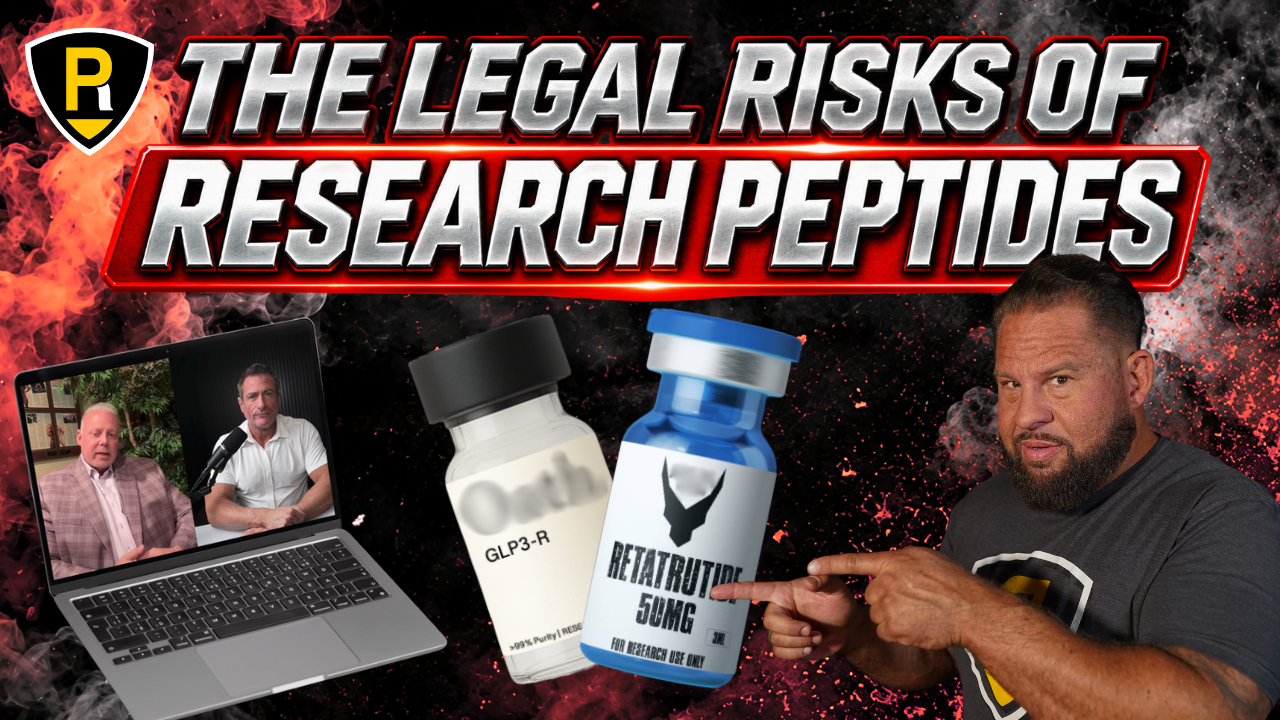
05 Nov The Legal Risks of Research Peptides: Rick Collins Explains Where the FDA Draws the Line
Article Rundown
- The research peptide market has expanded dramatically, bringing increased legal scrutiny from federal regulators.
- Rick Collins explains why “research use only” labels do not automatically protect vendors from FDA enforcement.
- Medical providers prescribing unapproved peptides may face legal liability and potential malpractice insurance complications.
- The Paradigm Peptides case highlights the serious consequences of fraudulent labeling, falsified testing certificates, and misleading product claims.
Update: 10/29/26
There is a temporary green light (no one knows what it means yet) on compound pharmacies. TB-500, BPC 157, and MOTS-C are temporarily able to produce. Research is still treated the same as either fraud or illegally distributing medication.
Rick Collins Explains Where the FDA Draws the Line
The research peptide market has exploded in popularity, but how many people selling, prescribing, or purchasing these compounds actually understand the legal risks involved? A simple label stating “for research use only” might seem like protection, but that does not necessarily mean much when federal regulators start investigating.
In Part 2 of my commentary on the Men’s Health Span podcast featuring attorney Rick Collins, we examine the growing legal scrutiny surrounding research peptides, compounding pharmacies, and online vendors. Rick has spent decades representing individuals and businesses involved in these industries, and his perspective offers important insight into where things are heading.
The Research Chemical Market Is Nothing New
One of the first things Rick explains is that the research chemical industry existed long before peptides became popular. Back in the early 2000s, websites were already selling compounds like tamoxifen, Clomid, and other medications commonly associated with bodybuilding and performance enhancement. These products were frequently marketed as research chemicals rather than substances intended for human consumption.
I remember when these websites started becoming more common. Rick actually wrote about this issue in 2005, warning that the government could eventually pursue businesses using research disclaimers to disguise products intended for human use. I read that article, and what stands out is how relevant those warnings remain today. The market has expanded significantly, particularly with compounds like BPC-157, TB-500, and newer peptides, but many of the underlying legal questions have stayed the same.
From Underground Bodybuilding to Mainstream Popularity
Years ago, research chemical websites primarily attracted people involved in bodybuilding and performance enhancement. Purchasing these products was considerably less mainstream, and the market operated largely outside public attention.
Today, the situation is completely different. Peptides have entered conversations about weight management, recovery, longevity, and general wellness. Online purchasing is easier, and the customer base has expanded far beyond competitive athletes. As Rick explains, that increased visibility has also attracted attention from regulators and created additional concerns for businesses operating in this space.
Are Medical Providers Protected When Prescribing Peptides?
Another important part of the discussion involves medical professionals who prescribe or administer unapproved compounds. Some practitioners may believe that operating through a clinic or compounding pharmacy automatically provides legal protection, but Rick explains why that assumption can be dangerous.
Depending on the compound, applicable laws, and insurance policy, prescribing an unapproved drug may create regulatory exposure or medical malpractice coverage problems. Some insurance policies specifically exclude certain treatments involving drugs that lack FDA approval. If a patient later files a lawsuit alleging an injury, a practitioner could discover that their insurer will not cover the claim. That is something clinicians need to understand before offering these treatments, not after a problem develops.
Why “Research Use Only” Does Not Guarantee Legal Protection
This is where Rick gets into one of the most important legal distinctions in the entire discussion. Selling an unapproved drug can create legal problems even when the product is labeled “not for human consumption.”
The FDA evaluates more than the wording on a bottle. Regulators can examine advertising, customer communications, purchasing patterns, and other evidence to determine a product’s intended use. If a business claims its products are exclusively for laboratory research while surrounding circumstances demonstrate that they are being marketed for human consumption, that disclaimer may not protect the seller.
Rick explains how these situations can lead to charges involving the introduction of unapproved or misbranded drugs into interstate commerce with intent to defraud or mislead. The underlying issue is not simply what the label says, but whether the business is misrepresenting its activities to avoid federal drug regulations.
The Paradigm Peptides Case: When Misrepresentation Goes Further
Rick then discusses the Paradigm Peptides case, which demonstrates how serious these situations can become. Federal authorities investigated the business for selling unapproved compounds while making misleading representations about its products.
What makes this case particularly concerning is that the problems extended beyond research disclaimers. The government identified false claims regarding where products were manufactured, inaccurate testing representations, and products marketed as selective androgen receptor modulators, or SARMs, that actually contained testosterone. SARMs are compounds designed to activate androgen receptors, while testosterone is a steroid hormone classified as a Schedule III controlled substance in the United States.
This is where I have a serious problem with what was happening. There is a difference between operating in a complicated regulatory environment and deliberately misleading customers about what they are purchasing. When companies misrepresent ingredients, manufacturing origins, or product quality, they are putting consumers at risk.
Forged Testing Certificates and the Importance of Transparency
Another major issue involves certificates of analysis, commonly called COAs. These documents are supposed to provide laboratory testing information about a product’s identity, purity, and sometimes its contaminants. They can be useful for evaluating quality, but only when the testing and documentation are legitimate.
According to the case discussed by Rick, certificates were falsified by altering information from other businesses’ testing documents. That is unacceptable. I’ve encountered companies that I believe take testing and transparency seriously, but that does not mean every vendor operates with the same standards. A professional-looking certificate is not enough if the information behind it cannot be trusted.
The Paradigm case illustrates how multiple forms of deception can compound the consequences. Misrepresenting intended use, product origins, laboratory testing, and ingredients creates an entirely different level of concern.
What the Peptide Industry Needs to Understand
My biggest takeaway from Rick’s explanation is that the research peptide industry cannot assume the rules will remain loosely enforced simply because certain business practices have existed for years.
There are legitimate questions about access to emerging compounds, medical supervision, and regulatory pathways. However, those discussions should never excuse dishonest labeling, fabricated testing, or misleading customers. Whether someone is a researcher, medical practitioner, vendor, or consumer, understanding what is actually being sold and how it is regulated matters.
As the market continues to grow, accountability and transparency will become increasingly important. Rick’s perspective makes one thing clear: a disclaimer alone is not a substitute for legal compliance, and the consequences of getting that wrong can be substantial.
Contact Info!
Brian Carroll Info:
Website: PowerRackStrength.com
Email: Brian@PowerRackStrength.com
Instagram: BrianCarroll1306
Rick Collins Info:
Website: RickCollins.com
Instagram: RickCollinsESQ
Men’s Health Span Info:
YouTube Channel: https://www.youtube.com/@menshealthspan
Full Podcast Covered in the video: https://www.youtube.com/watch?v=UhcKsWSMNB8
Buy Gift of Injury!
Buy Back Mechanic!
Buy Ultimate Back!

Buy Back Mechanic!
PRS Bands and Straps!


Sorry, the comment form is closed at this time.