



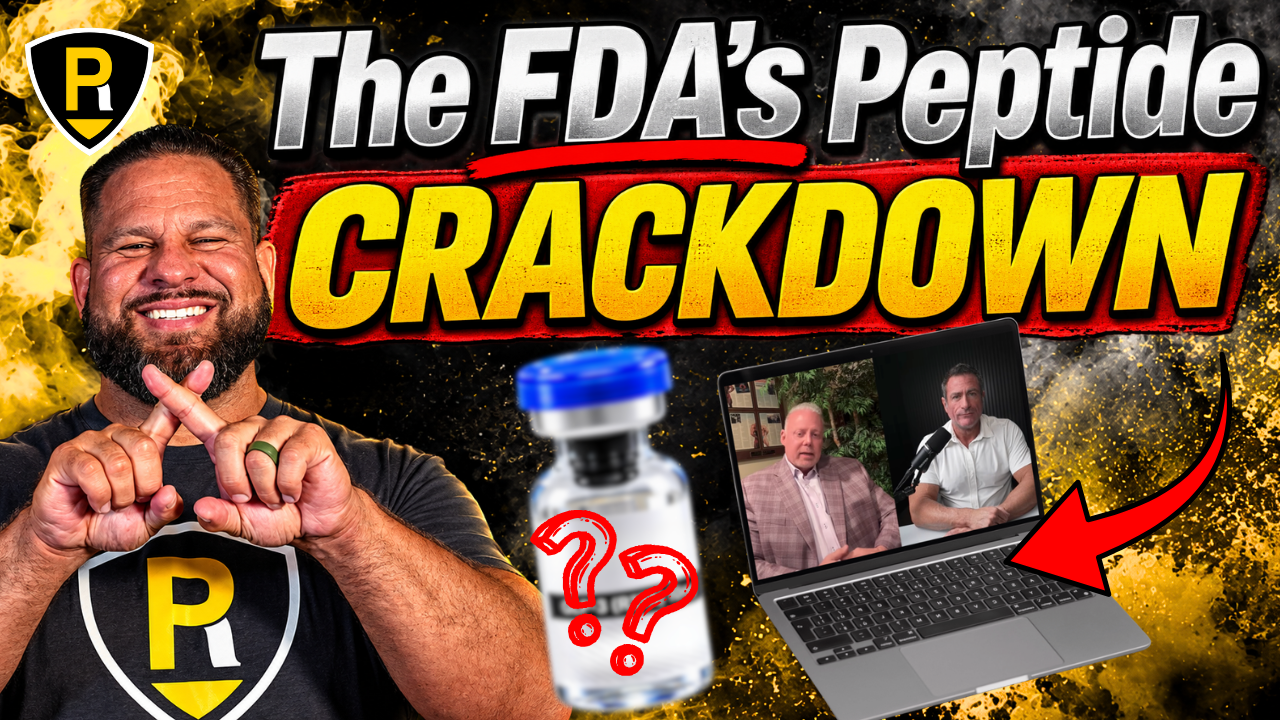
12 Nov The FDA’s Peptide Crackdown: Why Some Companies Get Caught, and Others Don’t
Article Rundown
- Rick Collins explains how research peptide companies attract FDA attention through complaints, investigations, and unpredictable circumstances.
- Limited enforcement resources mean many companies operate without intervention, but legal consequences can be severe when violations are pursued.
- FDA enforcement appears to be shifting from SARMs toward research peptides, with retatrutide becoming a particular focus.
- Brian examines pharmaceutical industry influence, potential peptide price increases, and the importance of understanding regulatory risks.
Update: 10/29/26
There is a temporary green light (no one knows what it means yet) on compound pharmacies. TB-500, BPC 157, and MOTS-C are temporarily able to produce. Research is still treated the same as either fraud or illegally distributing medication.
Why Some Companies Get Caught, and Others Don’t
The FDA’s crackdown on research peptides is raising plenty of questions, but one of the biggest is why certain companies get targeted while thousands of others continue operating. Is it the size of the business? The products they’re selling? Or is it simply a matter of being in the wrong place at the wrong time?
In Part 3 of my commentary on Rick Collins’ interview with Men’s Healthspan, we get into what I consider one of the most important parts of their discussion. Rick explains how companies attract federal attention, why enforcement can seem inconsistent, and which compounds appear to be drawing the most scrutiny. Having followed the research chemical industry for years, I think his explanation puts a lot of what’s happening into perspective.
How Research Peptide Companies Get on the FDA’s Radar
One question raised during the interview concerns Milestone Purity and what specifically brought the company to the government’s attention. As Rick Collins explains, federal agencies typically don’t publicize exactly what triggers an investigation.
Sometimes it’s a consumer complaint, an adverse event, or a company becoming too visible. Other times, someone facing legal trouble provides information about another business. An investigation can even begin through an unrelated encounter that leads authorities to a particular supplier.
That’s an important distinction. Just because one company gets investigated while another continues operating doesn’t necessarily mean the second company is doing anything differently or legally. There are numerous ways to attract attention, and predicting which businesses will become targets isn’t always possible.
The Speeding Analogy That Explains Federal Enforcement
Rick offers an analogy that I think explains this situation better than almost anything else: speeding. Imagine driving on a highway with a 55-mph speed limit. If you ask an attorney whether driving 60 or 65 is acceptable, the legal answer is straightforward. The speed limit is 55. Anything above that violates the law.
However, we all know people regularly exceed speed limits without receiving tickets. Law enforcement has limited resources and cannot stop every violation. The faster and more recklessly someone drives, the more attention they’re likely to attract, although even minor violations can result in consequences.
The research peptide industry presents a similar enforcement problem. With potentially thousands of websites selling these compounds, federal agencies cannot investigate every business simultaneously. But there’s one major difference. Getting caught speeding might cost you a fine. Getting caught illegally distributing unapproved drugs or committing fraud can lead to substantial financial penalties, criminal charges, and potentially imprisonment.
Rick makes another interesting observation. While the likelihood of any individual company being investigated may be relatively low, his legal practice remains extremely busy. That should tell you something about the consequences when enforcement does happen.
From SARMs to Peptides: Where Enforcement Is Heading
The conversation then shifts toward the types of cases Rick has been handling. He mentions steroid-related cases and other healthcare matters, but research peptides have become an increasingly important part of his work. Previously, selective androgen receptor modulators, commonly called SARMs, attracted considerable regulatory attention.
SARMs are compounds designed to selectively activate androgen receptors, often marketed for muscle growth and performance. They’re not FDA-approved for general human use, and regulators have raised concerns about cardiovascular, liver, and hormonal risks. Now, Rick believes attention is increasingly shifting toward peptides, particularly retatrutide.
Retatrutide is an investigational metabolic drug that activates GLP-1, GIP, and glucagon receptors. Its potential applications in obesity and metabolic health have generated significant interest, but that attention has also created a market for unauthorized versions.
Rick suggests that retatrutide may be helping drive broader enforcement involving other research peptides, including compounds marketed for recovery, tissue repair, and metabolic health.
Big Pharma, Retatrutide, and the Business of Regulation
One of Rick’s more interesting observations concerns Eli Lilly and the financial interests surrounding retatrutide. Pharmaceutical development requires enormous investment, and companies have obvious commercial reasons to protect their products from unauthorized competition. Rick believes pressure surrounding retatrutide may be influencing the direction of enforcement, although that doesn’t establish the motivation behind every FDA investigation.
I’ve been critical of the FDA before, and I believe regulatory decisions deserve scrutiny. At the same time, legitimate concerns involving product purity, potency, contamination, and consumer safety cannot simply be ignored.
Still, I think it’s important to recognize the business side of this industry. When major pharmaceutical companies invest heavily in drug development, unauthorized competition becomes more than just a regulatory question. It becomes a financial one.
What Happens to Peptide Prices if Regulation Tightens?
Another concern I have is affordability. If access to certain peptides becomes restricted to approved pharmaceutical channels, I worry that consumers could face substantially higher prices. A compound currently advertised by a research supplier for around $100 might eventually cost several times that amount through a regulated pharmaceutical model.
That isn’t a confirmed pricing forecast, and there’s no guarantee these compounds will receive approval. However, it’s a potential consequence worth considering, particularly for people interested in multiple compounds.
I don’t believe the public should ignore the value of quality control and pharmaceutical oversight. But I also don’t think affordability should be overlooked when discussing the future of these products.
Why Rick Collins’ Perspective Matters
I’ve followed Rick Collins for years, spoken with him before, and paid attention to his work involving performance-enhancing drugs and research chemicals. His experience representing people involved in these cases gives him a perspective that I think is incredibly valuable. He’s dealing with actual enforcement actions rather than simply speculating about what the government might do next.
My biggest takeaway from this interview is that limited enforcement doesn’t mean something is legal or safe. The government has limited resources, but when investigators pursue a case, allegations involving mislabeling, unauthorized drug sales, and fraud can carry serious consequences. Nobody can predict exactly what the FDA will do next. However, based on Rick’s observations and the direction of recent enforcement, I believe retatrutide and the broader research peptide market deserve particularly close attention.
The industry is changing, and understanding the difference between what’s being sold, what’s legally permitted, and what’s actually being enforced has never been more important.
Contact Info!
Brian Carroll Info:
Website: PowerRackStrength.com
Email: Brian@PowerRackStrength.com
Instagram: BrianCarroll1306
Rick Collins Info:
Website: RickCollins.com
Instagram: RickCollinsESQ
Men’s Health Span Info:
YouTube Channel: https://www.youtube.com/@menshealthspan
Full Podcast Covered in the video: https://www.youtube.com/watch?v=UhcKsWSMNB8
Buy Gift of Injury!
Buy Back Mechanic!

Buy Ultimate Back!

Buy Back Mechanic!
PRS Bands and Straps!


Sorry, the comment form is closed at this time.