



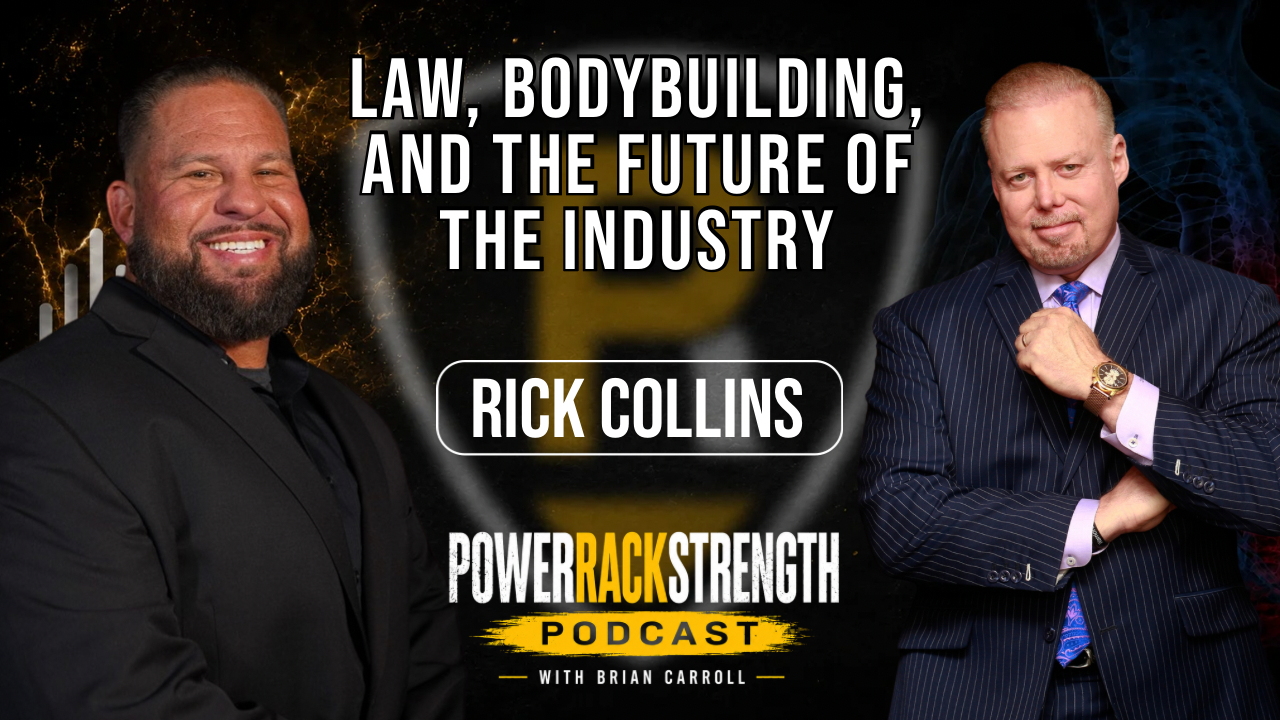
10 Oct From Anabolic Steroids to Peptides: Rick Collins on the Law, Bodybuilding, and the Future of the Industry
Watch the full video on Rumble!
Article Rundown
- Rick Collins shares how his bodybuilding background shaped his career defending athletes, supplement companies, and individuals facing legal challenges.
- Operation Raw Deal and federal steroid regulations transformed the industry, contributing to the growth of underground markets.
- Brian and Rick discuss misconceptions about anabolic steroids, legitimate health risks, and the importance of accurate information.
- The rapidly expanding peptide industry faces increasing legal scrutiny, raising questions about regulation, consumer safety, and future enforcement.
Rick Collins on the Law, Bodybuilding, and the Future of the Industry
What happens when the government cracks down on a substance, but the demand for it never disappears? That question has followed the fitness industry for decades, from anabolic steroids to the rapidly expanding peptide market.
I recently sat down with attorney Rick Collins, one of the most recognized legal professionals in the bodybuilding and performance-enhancement community. Rick helped me through a legal scare back in 2008, and I’ve respected his work ever since. We covered everything from bodybuilding history and criminal defense to Operation Raw Deal, underground laboratories, and the legal uncertainty surrounding peptides.
From Bodybuilding to the Courtroom
Rick’s background is unique. Before becoming an attorney, he competed in bodybuilding and pursued acting, including appearances in The Sopranos and The Toxic Avenger films. He also spent five years as a prosecutor before transitioning into criminal defense.
His bodybuilding experience eventually became an advantage in the courtroom. He understood the discipline, sacrifice, and culture surrounding serious training. When anabolic steroids became Schedule III controlled substances under federal law in 1990, Rick began representing individuals facing charges involving these products.
He later wrote Legal Muscle and spent more than two decades contributing to Muscular Development. His work helped connect two worlds that rarely understood each other: the fitness community and the legal system.
Strength, Confidence, and Professionalism
One thing Rick and I immediately connected on was how strength training influences life beyond the gym. My 21 years in competitive powerlifting taught me how to handle adversity, manage setbacks, and remain disciplined under pressure.
Rick experienced something similar through bodybuilding. We discussed how physical confidence can influence the way someone carries themselves, whether they’re entering a courtroom or handling an uncomfortable situation.
But there’s an important distinction between being powerful and acting aggressively. Being strong doesn’t mean you need to intimidate people. Rick explained that much of his legal work involves negotiation, where professionalism, patience, and respect often accomplish more than confrontation.
Bodybuilding Legends and Lessons From the Trenches
Naturally, we had to talk bodybuilding. Rick credited Arnold Schwarzenegger for his influence on the sport while identifying Ronnie Coleman’s prime physique as one of the greatest ever assembled. We discussed Dorian Yates, Flex Wheeler, and Paul Dillett, whose extraordinary size and structure made him a fascinating example of unrealized potential.
Our discussion also touched on Dexter Jackson, the history of bodybuilding gyms, and Rick’s involvement with the International Sports Hall of Fame.
We recognized Dr. Ken Kinakin for his work organizing SWIS symposiums, bringing together experts such as Professor Stuart McGill, Ed Coan, and other respected figures in strength, rehabilitation, and performance.
Operation Raw Deal and the Underground Market
The conversation eventually shifted toward Operation Raw Deal, the massive 2007 federal enforcement operation targeting anabolic steroid distribution networks.
Rick explained how the 1990 legislation transformed the steroid marketplace. As legitimate pharmaceutical access became more restricted, demand continued, creating opportunities for underground suppliers.
Products initially came through channels involving finished pharmaceutical and veterinary-labeled steroids. Later, raw materials imported from overseas became increasingly common, with underground laboratories manufacturing finished products.
Operation Raw Deal targeted these networks, but Rick questioned whether the broader enforcement strategy accomplished its intended goals. His argument was that restricting supply without addressing demand encouraged an expanding, increasingly difficult-to-regulate marketplace.
Underground Laboratories and Consumer Safety
Having dealt with underground laboratories throughout his career, Rick described substantial differences in manufacturing standards. Some operators reportedly maintained careful production practices, while others worked under conditions that raised serious contamination concerns.
I shared my experiences from earlier periods of bodybuilding and powerlifting culture, when message boards served as major sources for these products.
The larger concern is that consumers cannot reliably determine product quality simply from reputation or personal experience. Contamination, inaccurate concentrations, and unknown ingredients remain legitimate risks.
Rick’s position is that a properly regulated market could provide better oversight than outright prohibition.
Steroids, Public Perception, and Medical Risks
We also discussed how anabolic steroids became closely associated with cheating in sports, especially following Ben Johnson’s positive drug test at the 1988 Olympics.
Rick pointed to research examining users whose primary motivations were appearance and personal physique goals rather than competitive sports.
That distinction matters when discussing public perception, although it doesn’t eliminate health concerns.
We also addressed the popular concept of “roid rage.” Rick argued that the media has often exaggerated the stereotype, while acknowledging that some individuals experience mood and behavioral changes.
Anabolic steroids can carry serious risks, including cardiovascular complications, elevated blood pressure, liver injury with certain oral compounds, hormonal disruption, and psychological effects. Those concerns deserve accurate discussion rather than sensationalism or dismissal.
The Peptide Market Is Facing Similar Questions
From there, we moved into what may become one of the industry’s biggest legal battles: peptides.
Peptides are short chains of amino acids, some of which act as signaling molecules in the body. They include established prescription medications as well as experimental compounds that have not received FDA approval.
Products such as BPC-157, TB-500, and experimental weight-management compounds have attracted considerable attention. Meanwhile, approved GLP-1 medications have helped introduce injectable treatments to a much broader population.
Rick explained the legal distinctions among approved medications, pharmaceutical compounding, and products marketed as “research use only.” That label does not automatically protect a seller when a product is actually being promoted for human consumption.
Enforcement, Financial Exposure, and What’s Next
Rick described how companies selling unapproved peptides could face FDA enforcement, criminal investigations, civil litigation, and substantial financial consequences.
He also discussed the involvement of major pharmaceutical companies, including Eli Lilly, in pursuing sellers they believe are unlawfully competing with approved drug products.
His concern is that another sweeping enforcement campaign could repeat some of the unintended consequences seen in the anabolic steroid market.
We ultimately returned to the importance of informed decision-making, consumer safety, and regulatory accountability. People deserve accurate information about the products they’re considering, while businesses must recognize that popularity does not establish legality or safety.
The central question remains whether future regulation can protect consumers without simply driving demand further underground.
Buy Gift of Injury!
Buy Back Mechanic!
Buy Ultimate Back!

Buy Back Mechanic!
PRS Bands and Straps!


Sorry, the comment form is closed at this time.