



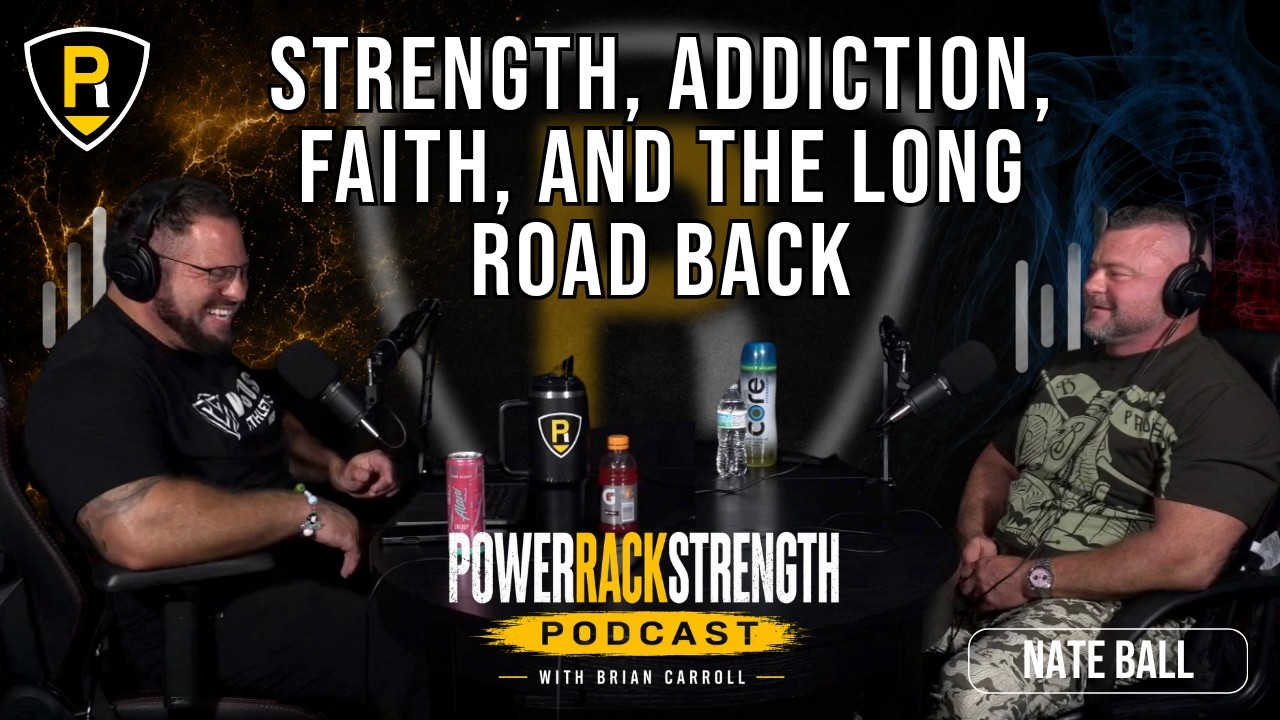
21 Aug Nate Ball: Strength, Addiction, Faith, and the Long Road Back
Watch the full video on Rumble!
Article Rundown
- Strength built through faith, resilience, and accountability
- Addiction and prison nearly cost Nate everything
- He rebuilt his family, business, health, and strength
- No matter how low you go, there is a way back
Strength, Addiction, Faith, and the Long Road Back
When people look at Nate Ball today, they see a strong guy in his 50s, a successful business owner, a husband, father, grandfather, powerlifter, and strongman. What they probably don’t see is everything it took for him to still be standing here.
This conversation wasn’t really about lifting. Lifting is certainly part of Nate’s story, but this was about what happens when somebody falls about as far as a person can fall, survives it, takes responsibility for it, and starts putting his life back together.
Strength Started as Protection
Nate grew up in a small town in northeast Arkansas and started lifting around 14 years old. But his reason for getting strong went much deeper than wanting a bigger bench press. Nate was sexually abused as a child by a family member, and lifting became a form of protection. He wanted to become big enough and strong enough that nobody could ever hurt him like that again.
That fear eventually turned into rage. Strength training gave Nate somewhere to put some of it, but it didn’t address what was underneath. As he got older, he started chasing intensity in other ways. Steroids, alcohol, drugs, dangerous situations, and eventually criminal behavior all became part of the same pattern.
Nate described constantly chasing that feeling of adrenaline and invincibility. The problem is that every time you need a little more to get the same feeling, eventually there isn’t much of a line left that you won’t cross.
Losing Everything
Nate built a successful business and made money, but addiction eventually took almost everything from him. At his lowest point, he was isolated from his wife and children, living without basic utilities in a house that had essentially become a drug den, while the business he had built collapsed around him. He estimates that he burned through hundreds of thousands of dollars in roughly 18 months.
This is also where I think accountability becomes important. Nate doesn’t use what happened to him as a child to excuse what he did as an adult. Trauma can help explain how somebody gets somewhere, but explanation and accountability can exist at the same time.
Nate made choices. Those choices hurt his family, destroyed relationships, wrecked his business, and eventually landed him in federal prison.
Rock Bottom Wasn’t the End
Prison became one of the major turning points. Around Christmas 2009, Nate remembers looking outside from federal prison, believing he had lost everything. His wife was gone. His children were gone. His parents weren’t speaking to him. He was facing years behind bars and couldn’t imagine the life he has today. This is where his faith began becoming real again.
Nate had grown up knowing God, but he had spent years running in the opposite direction. In prison, removed from the drugs and chaos, he began confronting what his life had become. That process wasn’t magical, and rebuilding wasn’t instant. When Nate eventually got back out, he still had to work.
Faith With Some Muscle Behind It
One thing Nate said during our conversation stuck with me. He believes God restored what he had lost, but he didn’t sit around waiting for his life to magically rebuild itself. He worked. He started over, making a few hundred dollars a week. He knocked on doors. He heard no repeatedly. Then he showed back up and asked again. Some of those relationships eventually became long-term business relationships that still exist today.
That’s where Nate made the point that sometimes faith needs some muscle behind it. You pray. You ask for help. You trust God. But then you still put your boots on and go to work. Today, his business has been rebuilt, his family is back in his life, and after 30 years of marriage, he talks about continuing to “date” his wife and earn that relationship every day.
The Physical Battles Weren’t Over
Getting sober and rebuilding his life didn’t mean Nate suddenly stopped paying for his past or stopped facing adversity. He went through major heart surgery. He tore both triceps in a skiing accident. He dealt with debilitating back problems that reached the point where he wasn’t sure he ever wanted a bar on his back again.
When Nate and I started working together on his back, the goal wasn’t simply to make him tolerate pain. We needed to understand what was provoking it and build him back intelligently. Eventually, the guy who didn’t think he wanted to squat again put more than 550 pounds on his back and pulled more than 600. Less than a year after quadruple bypass surgery, he traveled to Iceland and shouldered the Halfsterkur stone, something he considers one of the greatest strength accomplishments of his life. Those numbers are impressive, but they’re almost secondary to what they represent.
You Are Never Too Far Gone
Toward the end of our conversation, Nate said he learned that rock bottom has a basement, and the basement can have another trap door. He’s been addicted. He’s been homeless. He’s been incarcerated. He’s lost his business, damaged his family, undergone heart surgery, torn both triceps, and lived with debilitating back pain. He’s still here.
Now he goes back into prisons and talks to men who may believe their lives are already over. His message is simple: no matter how low you’ve gone, there is still a way out. But you have to become willing to ask for help, accept it, and then do the work. That’s what real strength looks like to me.
It isn’t pretending you never screwed up. It isn’t acting like you don’t need anybody. Sometimes the strongest thing you can do is admit exactly where you are, humble yourself enough to accept help, put your faith in something greater than yourself, and start climbing back out. Nate has done that physically, mentally, spiritually, financially, and with his family. At 52 years old, he’s still climbing.
Buy Gift of Injury!
Buy Back Mechanic!
Buy 10/20/Life!

Buy Ultimate Back!

Sorry, the comment form is closed at this time.