



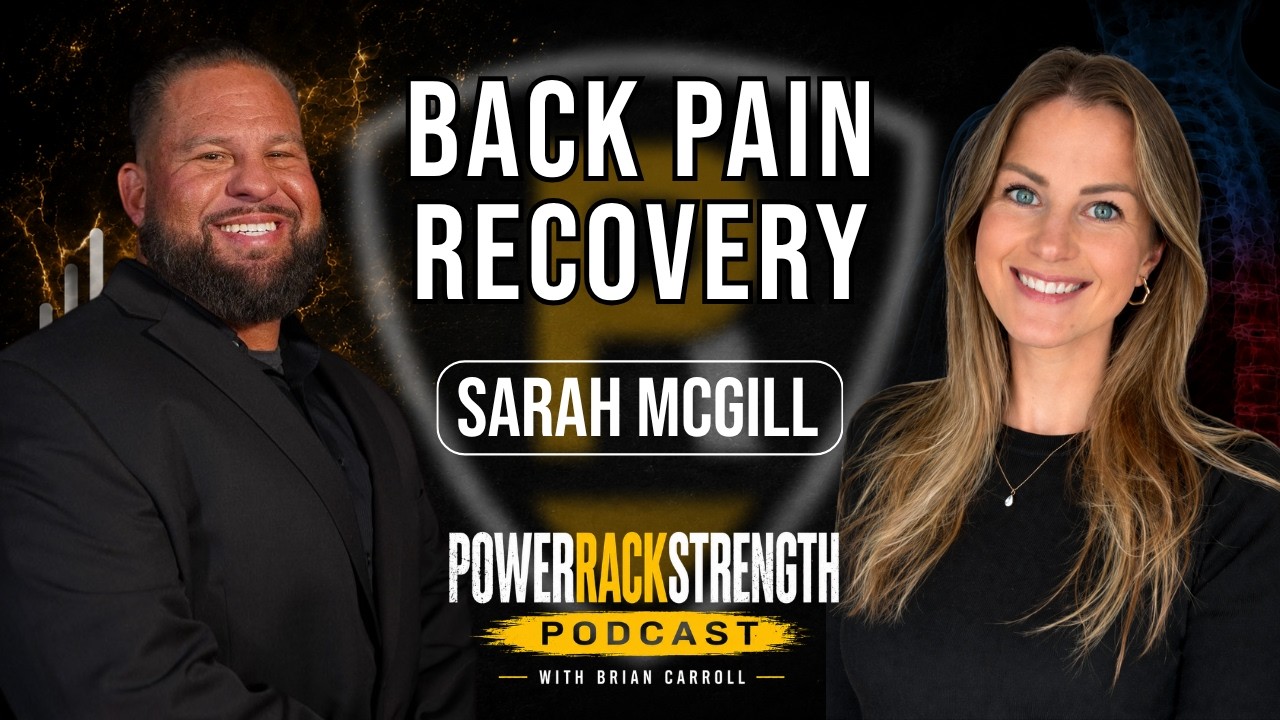
19 Jun The Art and Science of the McGill Method: A Conversation With Sarah McGill
Watch the full video on Rumble!
Article Rundown
- I reflect on meeting Professor McGill and starting my back recovery journey.
- I introduce Sarah McGill and her role with BackFitPro.
- We discuss why back pain assessments must be specific, not cookie-cutter.
- We talk about breathwork, listening, and lifestyle context in recovery.
The Art and Science of the McGill Method
I’ve known the McGill family for a long time now. Almost exactly 13 years ago, on May 1st, 2013, I made my first trip up to Waterloo to meet Professor Stuart McGill. At that point, my back was wrecked, my lifting career was hanging by a thread, and I needed answers that nobody else had been able to give me.
Stu gave me those answers. He helped me understand what was causing my pain, what my spine needed to heal, and why taking time away from heavy lifting was not weakness — it was the only path forward. Of course, being me, I negotiated with him. I told him, “If you get me pain-free, I’m going back to lifting. I’m going to try to get my record back.” He was stern, but he left the door open. He said, “Get pain-free first. Then who knows? Maybe you’re right.” That journey eventually turned into Gift of Injury.
That same trip was also the first time I met Sarah McGill. She was 18 at the time, and now, all these years later, she is not only Professor McGill’s daughter, but the president of BackFitPro, a McGill Method-certified practitioner, and someone helping carry this work forward in her own way.
Who Is Sarah McGill?
Sarah wears a lot of hats. Professionally, she runs much of the BackFitPro operation, including the McGill Method certification process, continuing education for providers, clinical courses, written and practical examinations, and helping connect people in pain with the right resources.
She also sees clients herself, focusing on low back pain through the McGill Method, while adding her own background in training, breathwork, mindfulness, and restorative practices. That is one of the things I appreciate about Sarah: she respects the foundation her dad built, but she is not trying to be a clone of him. She is learning the method, practicing the method, and bringing her own personality and tools into the process.
And outside of work, she is a passionate Canadian “water girl,” as she describes it. Sailing, paddling, swimming, cooking, learning guitar — she is someone who loves to learn and loves life. That matters, because when you’re dealing with people in chronic pain, you can’t just be a technician. You have to be human.
Working Beside Professor McGill
One of the things Sarah and I talked about is what it’s like to learn from Professor McGill while also working with him. I know the pressure of that firsthand. I’ve been in assessments with Stu where I could feel him waiting to see if I would make the right decision. Sometimes there are three choices in front of you: one bad, one decent, and one that is exactly right. When you’re dealing with a sensitive spine, limited capacity, and a client who could go into spasm if you choose wrong, that pressure is real.
Sarah described it perfectly. It is not necessarily “pressure” in a negative way, but there is a weight to having him in the room because his brain is already a few steps ahead. He is building the next test, the next hypothesis, the next modification, while you are still processing what just happened.
That is where the McGill Method becomes more than a list of tests or exercises. It becomes art built on science. Professor McGill has the foundation from decades in the lab and clinic, but each person who walks in is a different canvas. Different injury history, different spine, different psychology, different fear level, different goals, different capacity.
The McGill Method Is Not Cookie-Cutter
This is something people constantly get wrong.
The McGill Method is not “never flex your spine and do the Big Three.” That is a cartoon version of the work. Back Mechanic is a great starting point for many people, but it is not the entire method. There are endless ways to modify a bird dog, side plank, curl-up, thoracic extension, walking pattern, bracing strategy, or nerve mobilization depending on the person in front of you.
Some people cannot tolerate compression or shear enough to do any of the Big Three on day one. Some people may actually need a little flexion as part of their antidote, especially if they are dealing with stenosis or certain arthritic presentations. That blows people’s minds because they want a simple rule. But spines do not work that way.
The goal is not to force everyone into one template. The goal is to investigate. What causes pain? What removes pain? What loads are tolerated? What movements create symptoms? What position gives respite? Then the plan has to match the findings one-to-one.
The Assessment Is an Investigation
Sarah gave a great analogy: the McGill assessment is like investigating a crime scene. The crime is the back pain. The client’s story gives clues. The interview builds the hypothesis. The physical assessment tests that hypothesis.
A big difference between this and many standard appointments is that we are not rushing to talk over the client or show them how much we know. We shut up, listen, observe, and test. A person may say they have SI joint pain, but when we test them, the real driver may be referred nerve root pain coming from the spine. The location of pain is not always the cause of pain.
That is why the assessment has to be flexible. A slump test is not just a slump test. You can change neck position, leg position, ankle position, arm position, nerve tension, and movement strategy to learn more. A test can become part of the therapy. A therapy can become part of the test. That is the art of the method.
Breathwork, Bracing, and Calming the System
Sarah also brings in breathwork where appropriate. Not as some random add-on, but as a tool that fits the person. Many people in pain are wound up, anxious, guarded, and stuck in a sympathetic state. Finding a position of respite, then using slow breathing or an extended exhale, can help calm the nervous system.
But there is nuance here too. If someone needs spine stability, they cannot fully relax into belly breathing while unsupported. There is a difference between breathing in a safe, unloaded position and breathing while braced under load. Sarah described it like a dimmer switch: sometimes you need a little brace and a little breath, sometimes you need more stiffness, and sometimes you need full relaxation in a supported position.
That is coaching. That is not just handing someone an exercise sheet.
Hope for the Person Who Feels Stuck
The biggest message from this conversation is simple: if you are stuck in back pain, there is still hope.
Many people who come to us have been in pain for years. They have tried physical therapy, chiropractic care, injections, rest, stretching, strengthening, YouTube exercises, and everything else. But many of them have never had a true assessment where someone sat down, listened to their story, tested their pain triggers, found their positions of relief, and built a plan that matched their exact presentation.
Sarah’s advice was excellent: become an investigator of your own pain. Start noticing what makes it worse, what makes it better, what your capacity is, and what patterns show up in your day. If sitting in one chair flares you up but another helps, that matters. If pain starts after 75 minutes of biking, that matters. If a certain movement lights you up every time, that matters.
The details are where the answers live. And when you find the right details, you can start building your way back.
Buy Gift of Injury!
Buy Back Mechanic!
Buy Ultimate Back!
Buy 10/20/Life!
New PRS Training System!

Sorry, the comment form is closed at this time.