



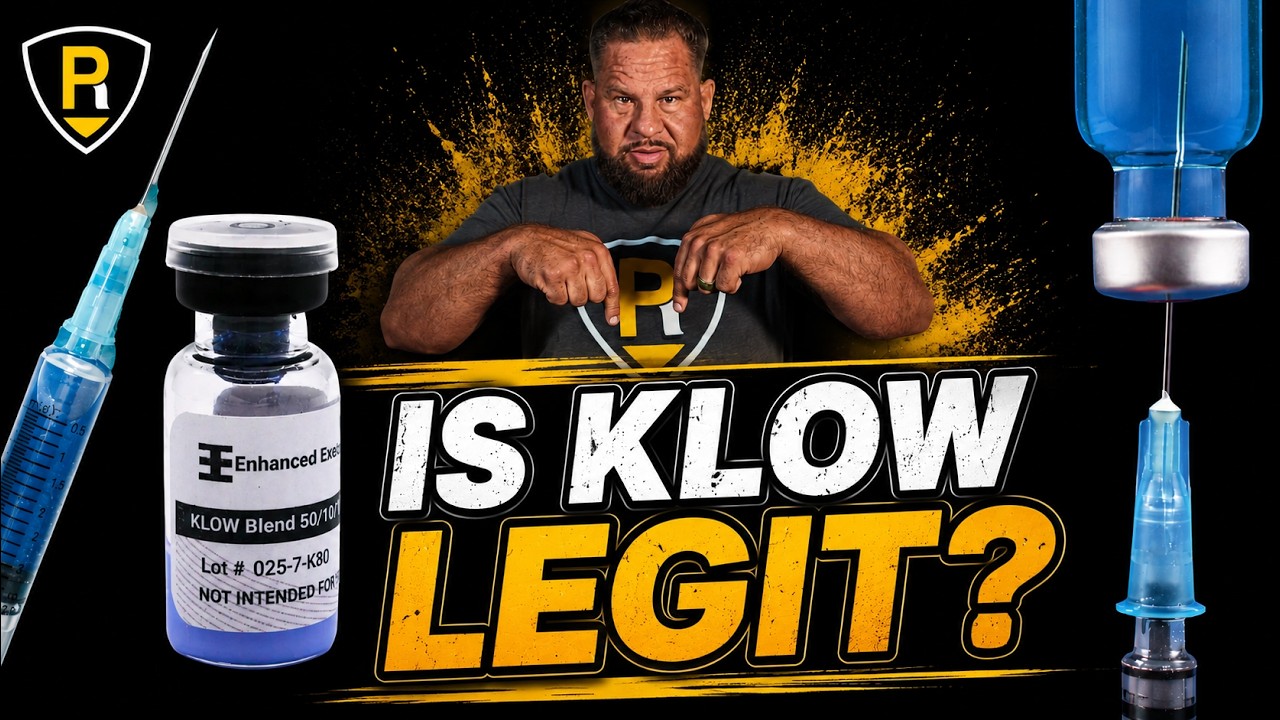
17 Jun Is The Peptide Blend ‘KLOW’ Legit?
Watch the full video on Rumble!
Article Rundown
- KLOW combines GHK-Cu, BPC-157, TB-500, and KPV to support tissue healing, inflammation control, and recovery.
- The individual doses may look low compared to taking each peptide separately, but the blend may work through a synergistic effect.
- Local injections near the injured area may help some people, but they can also cause a temporary inflammatory flare-up.
- KLOW is not magic, but when used properly and paired with removing the actual mechanical trigger, it may be a useful recovery tool.
Is The Peptide Blend ‘KLOW’ Legit?
Peptides are a hot topic right now, and one of the names that keeps coming up is KLOW. A lot of people are asking the same question: is KLOW actually legit, or is it just another overhyped blend being pushed because peptides are popular?
My answer is pretty simple: yes, KLOW can be legit — but you need to understand what it is, what it is not, and how it may fit into a bigger strategy.
KLOW is typically a blend that includes GHK-Cu, BPC-157, TB-500, and KPV. The exact dosing can vary depending on the source and protocol, but the general idea is combining peptides that may support healing, tissue repair, inflammation control, and recovery. That is where a lot of the conversation starts, because many people are used to taking these compounds separately at higher individual doses.
Why the Dosing Confuses People
This is where people tend to get hung up. BPC-157 and TB-500 have been around for a long time, and many people are familiar with the common dosing strategies. For BPC-157, you will often hear people talk about roughly 350 micrograms twice per day. With TB-500, some people take it daily, while others may use a few milligrams per week or more, split into different doses. Then they look at a KLOW blend and say, “Wait a minute, the individual doses are lower. That cannot be enough.”
I understand why someone would think that. On paper, the numbers can look underdosed compared to taking each peptide separately. But the argument for KLOW is not simply that each ingredient is maxed out individually. The argument is that the blend may have a synergistic effect, especially when you combine BPC-157 and TB-500 with GHK-Cu and KPV.
That does not mean every blend is good. Some blends are stupid. Some are poorly thought out. Some are just marketing. With KLOW, I do think there is a legitimate case for why the combination can work, and I have personally had success with it.
The Role of GHK-Cu and KPV
The two pieces that make KLOW interesting to me are GHK-Cu and KPV. GHK-Cu is extremely popular right now, especially in dermatology, regenerative medicine, and tissue-health conversations. You see it showing up in skin products, injection protocols, and clinics focused on recovery and repair. It is not some random compound nobody is talking about.
KPV is another important piece. It is not as widely known as BPC-157 or TB-500, but it is becoming more popular because of its potential role in systemic inflammation. And when you are dealing with irritated tissue, chronic pain, or a soft-tissue issue that will not calm down, systemic inflammation matters.
That is one reason I do not automatically dismiss the lower-dose blend argument. Sometimes the total effect of the combination may be more important than looking at one compound in isolation.
Should You Inject KLOW Locally?
A common question is whether KLOW should be injected directly near the injured area. Here is how I would answer that if you were my friend sitting across from me: I am not giving medical advice, and I am not telling you what to take. But I can tell you how I think about it.
Some people do very well putting it near the area that is irritated — an elbow, knee, hamstring, adductor, or whatever soft-tissue issue they are dealing with. Even though these peptides still work systemically, targeting the area around the irritated tissue may seem to speed things up for some people. But there is another side to that.
Some people report that the local injection hurts worse than the actual injury. They get a big inflammatory response, the area gets angry, and then they abandon it and go back to subcutaneous injections in the stomach.
I have used it both ways. With my own hamstring and adductor issue, I have tried putting it closer to the area. Sometimes I regret it because the area gets inflamed and irritated. Over time, there may still be a net positive, but that does not mean it feels good in the short term. So no, it does not have to go directly into the injured area. You can use it systemically. And depending on how your body responds, that may be the better option.
Local Irritation Does Not Always Mean Failure
This is important: sometimes a treatment can make something feel worse before it feels better. That does not automatically mean it failed. I have talked to people who used it locally, had a significant inflammatory response, felt worse for a short period, and then came out better a week or two later. But that does not mean you should keep hammering the irritated area if your body is telling you it is too much.
Sometimes you need to back off, go subcutaneous, and let the system calm down. That is what I have done at times. Instead of putting it directly into the hamstring, sartorius, TFL, or adductor area, I have simply gone subcutaneous in the stomach twice per day and let it work from there.
Is KLOW Just Hype?
No, I do not think KLOW is just hype. There is real science behind the individual compounds. BPC-157 and TB-500 have been discussed for years. GHK-Cu is very popular right now in regenerative and dermatology circles. KPV is gaining attention for systemic inflammation.
Now, that does not mean every person should take it. It does not mean you should grab random peptides from random places and start experimenting. And it definitely does not mean peptides replace the fundamentals.
If you have a mechanical trigger causing your pain, you still need to address the mechanical trigger. That is my lane. You have to remove the thing that keeps provoking the tissue, tune the body, rebuild capacity, and stop repeatedly irritating the same problem. Peptides may help support the process, but they do not replace the process.
Final Thoughts
So, is KLOW legit? In my opinion, yes, KLOW can be legit, especially when used intelligently as part of a larger strategy. The blend may offer a cost-effective way to combine GHK-Cu, BPC-157, TB-500, and KPV without having to run each compound separately at higher individual doses.
But it needs to be respected. Local injections may help some people, but they may flare others up. Subcutaneous use may be more tolerable. And if you are layering KLOW with other peptides or trying to manage a more complex pain or inflammation issue, that is where you need someone who really understands this space.
As always, consult your medical provider. I stay in my lane: helping people remove the mechanical triggers of their back pain and rebuild their bodies the right way. When it comes to advanced peptide layering and systemic inflammation strategies, that is when I lean on people who focus deeply on that world. KLOW is not magic. But used correctly, it may be a very useful tool.
Buy Gift of Injury!

Buy Back Mechanic!
Buy Ultimate Back!

Buy 10/20/Life!


Sorry, the comment form is closed at this time.