



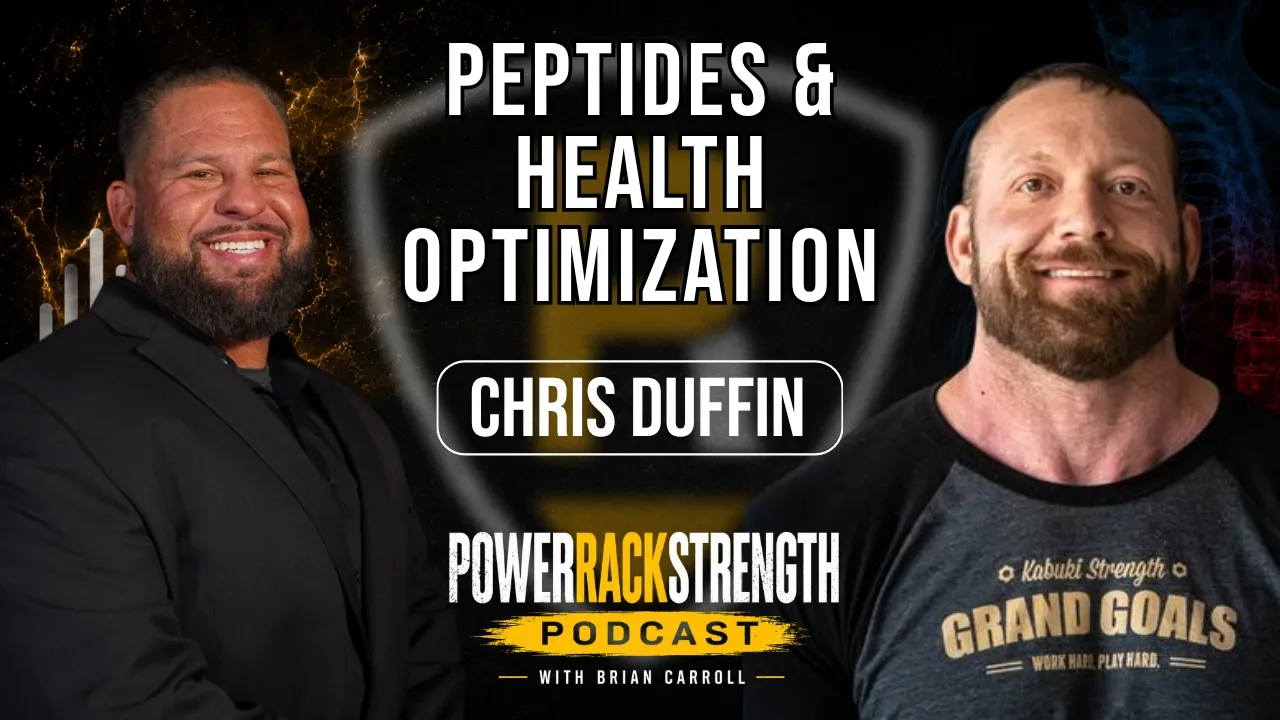
17 Jul Podcast With Chris Duffin: From Chasing Strength to Restoring Health
Watch the full video on Rumble!
Article Rundown
- Competition eventually stopped serving the bigger goal.
- Chris evolved from strength optimization to health restoration.
- You cannot biohack around poor movement and recovery.
- Lasting change begins with leading yourself first.
From Chasing Strength to Restoring Health
I’ve known Chris Duffin for a long time. We were first connected through Larry Hook during our powerlifting years, and we later reconnected at EXOS while helping educate coaches who worked with professional and Olympic-level athletes.
At that point, Chris and I were both still deeply connected to strength, performance and pushing the limits of what the human body could handle. However, Chris was already starting to recognize something that took me a few more years to fully understand.
Eventually, the desire to keep proving yourself under competition conditions begins to fade.
When Competition No Longer Serves the Goal
Chris was dealing with severely damaged elbows, compromised training and a growing realization that competition was no longer allowing him to express his true capabilities.
The bench press was taking so much out of his body that it affected his shoulders, squat and the rest of his total. Instead of discovering what he was capable of, he was spending most of his energy trying to survive the conditions required to compete. That doesn’t mean the fire disappeared.
Chris still wanted to push himself, explore his limits and see what he could accomplish. He simply stopped needing a federation, record book or competition platform to validate it. I understand that now. There comes a point where you realize the journey was never entirely about the number. It was about what you had to become to pursue it.
The Mad Scientist Was Always More Than a Powerlifter
Most people know Chris as the Mad Scientist of Strength. They remember the massive squats, enormous deadlifts, experimental equipment and the crazy feats that helped build his reputation.
However, the scientific and analytical side of Chris was never limited to lifting weights. He has two engineering degrees, a master’s degree in business, patents, years of corporate leadership experience and decades of experience studying how different inputs create changes throughout the body. Even his strength equipment was built around a deeper question: How can we alter the signal going into the body to produce a better result?
Changing the position of a squat bar, improving the length-tension relationship of a muscle or reducing a neurological threat response can completely change how the body performs. The equipment may appear mechanical, but the outcome is neurological, muscular, and chemical. That same way of thinking eventually led Chris deeper into recovery, peptides, cellular health, and longevity.
Experience Built Over Decades
Chris began experimenting with peptides more than two decades ago, long before they became a common topic online. His expertise is not based on pretending to be a physician. He is very clear that he works as a consultant and partners with qualified medical professionals when medical care is required. What he brings is decades of practical experience.
He has studied how different signaling compounds may influence recovery, tissue healing, performance and health. More importantly, he understands that no compound operates in isolation. A peptide cannot permanently fix a shoulder if the person continues moving poorly and repeatedly irritating the same tissue. In the same way, perfect movement and intelligent programming may only take someone so far if an autoimmune condition, nerve injury or cellular dysfunction is limiting recovery.
This is where our work overlaps. I address the mechanical side: the assessment, injury mechanism, movement strategy, load management and progressive rebuilding. Chris can help address areas that exist beyond my scope, including biochemical, hormonal and cellular factors. Neither side should be viewed as the entire solution.
The Rise of the Boardroom Athlete
Chris now works with many people he describes as “boardroom athletes.” These are executives, entrepreneurs, and other high performers who have spent decades living under extreme pressure. They may not have a barbell on their back, but they have accumulated their own version of training stress.
They travel constantly, sleep poorly, sit for long periods, manage enormous responsibilities and remain mentally activated throughout the day. Some train aggressively on top of that without having enough recovery to support it. Eventually, the mismatch catches up with them.
Hormones become disrupted. Sleep declines. Pain appears. Energy production suffers. Recovery slows down. The person may still look successful from the outside, but internally, the system is beginning to break down. That is not entirely different from what Chris and I did through powerlifting. We simply used a different form of stress.
You Cannot Bio-Hack Around the Problem
One point we both strongly agree on is that there is no single tool that fixes everything. You cannot inject your way around poor movement. You cannot train your way through every biochemical problem. You cannot out-supplement terrible sleep, uncontrolled stress, and a life that is constantly pulling you away from your health.
The body is a connected system. Mechanical stress affects chemical signaling. Psychological stress affects recovery. Poor recovery changes movement and performance. Each part influences the others. The answer is not to chase one miracle exercise, drug, peptide or protocol. The answer is to accurately identify what is limiting the person and then address the appropriate layer of the problem.
Lead Yourself First
Chris’s book, The Eagle and the Dragon, goes well beyond strength or health. It is about taking responsibility for your life, understanding what is holding you back and deliberately choosing who you want to become. That may be the most important part of this entire conversation.
You cannot lead a team, change an organization or rebuild your health if you cannot first lead yourself. That means taking radical responsibility, even when other people contributed to the situation. Chris experienced a hostile takeover of the company he built, but instead of placing all the blame elsewhere, he looked at what he could have managed differently.
That mindset does not erase what happened. It gives you the power to learn from it. Whether we are discussing leadership, back pain, athletic performance or long-term health, the principle remains the same: Understand the problem. Accept responsibility for what you can control. Build the correct plan. Then execute it consistently. That is how you create lasting change.
Buy Gift of Injury!
Buy Back Mechanic!
Buy Ultimate Back!
Buy 10/20/Life!

New PRS Training System!

Sorry, the comment form is closed at this time.