



03 Jun Spine Injuries Are Not All the Same
Article Rundown
- Not all spine injuries are the same, even if MRI reports use similar words.
- The mechanism behind the pain matters more than the diagnosis label.
- Disc issues often build from repeated flexion, compression, fatigue, and poor movement patterns.
- Assessment comes first so you stop guessing and start fixing the actual cause.
Spine Injuries Are Not All the Same
One of the biggest mistakes people make with back pain is assuming that every spine injury is the same. They hear the words “disc bulge,” “herniation,” “degeneration,” or “annular tear,” and they immediately think they know what they are dealing with. Maybe their coach had something similar. Maybe their friend had the same words written on an MRI report. Maybe a doctor told them they just have to live with it.
But that is not how the spine works.
Your spine is unique. Your injury mechanism is unique. Your movement history, your training history, your anatomy, and your pain triggers all matter. Just because two MRI reports use similar language does not mean two people have the same injury or need the same solution. This is why I always come back to the same starting point: you need to understand the mechanism behind the pain, not just the label attached to it.
The Spine Is More Than Just a Disc
When most people talk about back injuries, they immediately talk about the disc. That makes sense because disc injuries are common, but the spine is much more than one structure.
You have the spinal cord running through the center, protected by the vertebrae. You have discs between the bones that help absorb compression, maintain space, and distribute force. You have joints, ligaments, muscles, and connective tissue all working together to control movement and protect the nervous system.
The spine is a system. When one part of that system starts to break down, other areas often compensate. If the hips lose mobility, the motion may start coming from the low back. If the upper back loses extension, a lifter may start rounding through the thoracolumbar junction, where the upper and lower spine meet. Over time, those compensations can create stress in places that were never meant to take that kind of load.
Disc Injuries Usually Have a Mechanism
A disc is a pressurized structure. It is designed to absorb and distribute force, but it works best when stiffness and hydraulic pressure are maintained. When you repeatedly bend forward under load, train in fatigue, move poorly, or twist under compression, the disc can begin to change.
The outer rings of the disc, called the annulus, can weaken. Small tears can develop. The collagen can soften and break down. Over time, the disc may lose stiffness and become less predictable under load.
This is where people get into trouble. They think the problem is simply “a disc issue,” but often the bigger problem is the way the spine is behaving under stress. Once the disc loses stiffness and pressure, the segment may not move or load the way it should. That is when instability, irritation, and compensation can start to enter the picture.
The Label Is Not the Whole Story
People get caught up in MRI language. Bulge. Herniation. Protrusion. Extrusion. Degeneration. Annular tear. Those words matter, but they are not the full story. What matters more is how that injury behaves. Does flexion trigger symptoms? Does compression make it worse? Does sitting flare it up? Does twisting create pain? Is there nerve irritation? Is the pain localized, or does it travel?
The outer layer of the disc has nerve supply, which means irritation there can create deep, localized back pain, sharp discomfort, aching, or constant irritation. If inflammation or disc material affects nearby nerve roots, symptoms can change entirely. You may start dealing with pain, numbness, tingling, or weakness that travels away from the spine.
That is why copying someone else’s rehab plan is risky. Two people can both be told they have a disc herniation, but their pain triggers, injury history, and movement faults may be completely different.
Most Spine Injuries Build Over Time
Most of these injuries do not happen from one random movement. That final moment may be what you remember, but the process usually started much earlier.
Repeated flexion under load, fatigue under load, twisting, poor movement patterns, and accumulated stress all add up. Eventually, the tipping point gets crossed. The person bends over, sneezes, picks something up, or trains through one more bad rep, and suddenly the pain shows up. That one moment was not the whole injury. It was the final straw.
This is why I care so much about assessment. You have to identify what stress is being applied to your spine day after day. You have to figure out which movements are feeding the pain. Otherwise, you are just guessing.
The Spine Injury Cascade
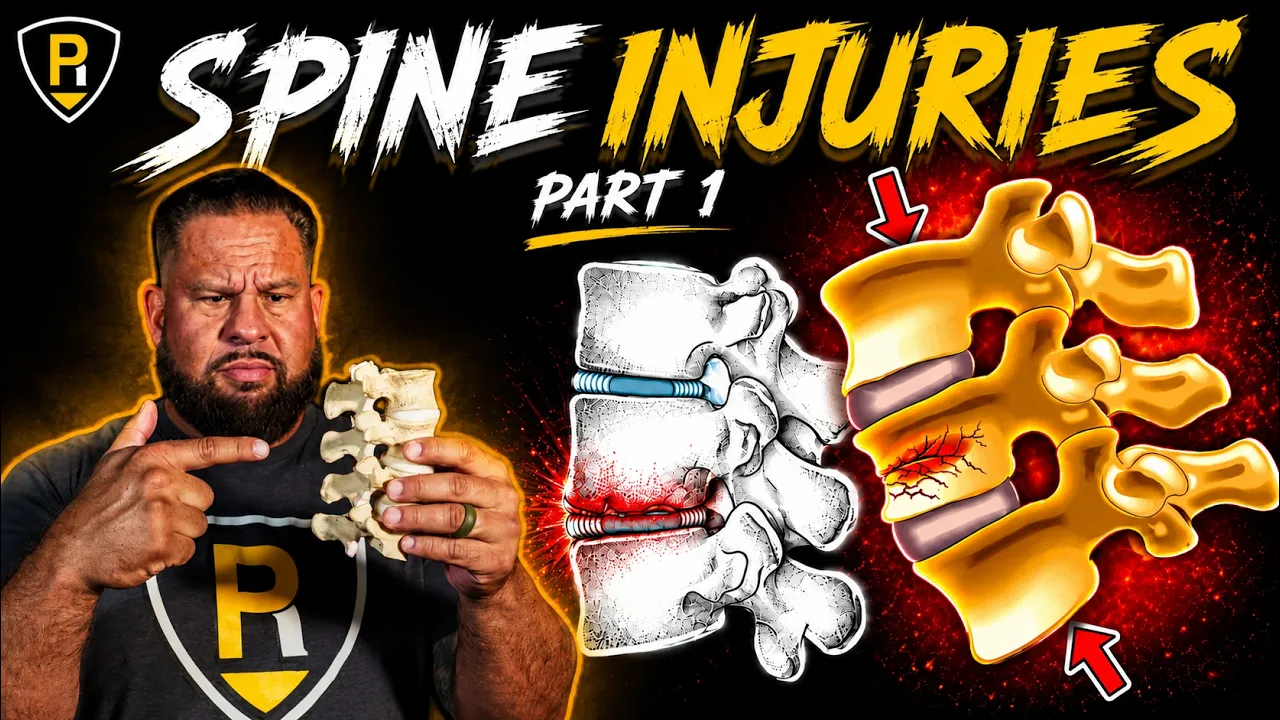
Over time, a disc can lose height and stiffness. When that happens, the endplates can also become involved. The endplates are the cartilage structures above and below the disc that help transfer load between the disc and the vertebrae. They also play a role in how the disc receives nutrients.
If stress exceeds tolerance, those endplates can become damaged. In some cases, they can fracture. The disc can start to push into the endplate above or below it, and now you are dealing with more than just a simple disc problem. The vertebral body itself may begin to take more stress, and the injury cascade can continue.
This is the bigger picture that often gets missed. Back pain is not always just about one disc, one MRI finding, or one exercise. It is about how the entire spine is tolerating load and movement.
Why Assessment Comes First
The main point is simple: do not treat your spine like everyone else’s spine.
Your MRI report does not tell the whole story. Your friend’s recovery plan may not fit you. Your coach’s injury may sound similar, but it may not behave anything like yours. The real question is not just, “What is the diagnosis?” The better question is, “What is the mechanism?”
Once you understand the mechanism, you can make better decisions. You can remove the movements that are feeding the pain, rebuild capacity, improve your mechanics, and stop guessing.
That is how you get out of the cycle. Not by chasing random exercises. Not by stretching everything. Not by assuming all spine injuries are the same. You start by understanding what is actually happening, then you build the plan around that.
Buy Gift of Injury!

Buy Back Mechanic!
Buy Ultimate Back!
Buy 10/20/Life!


Sorry, the comment form is closed at this time.