



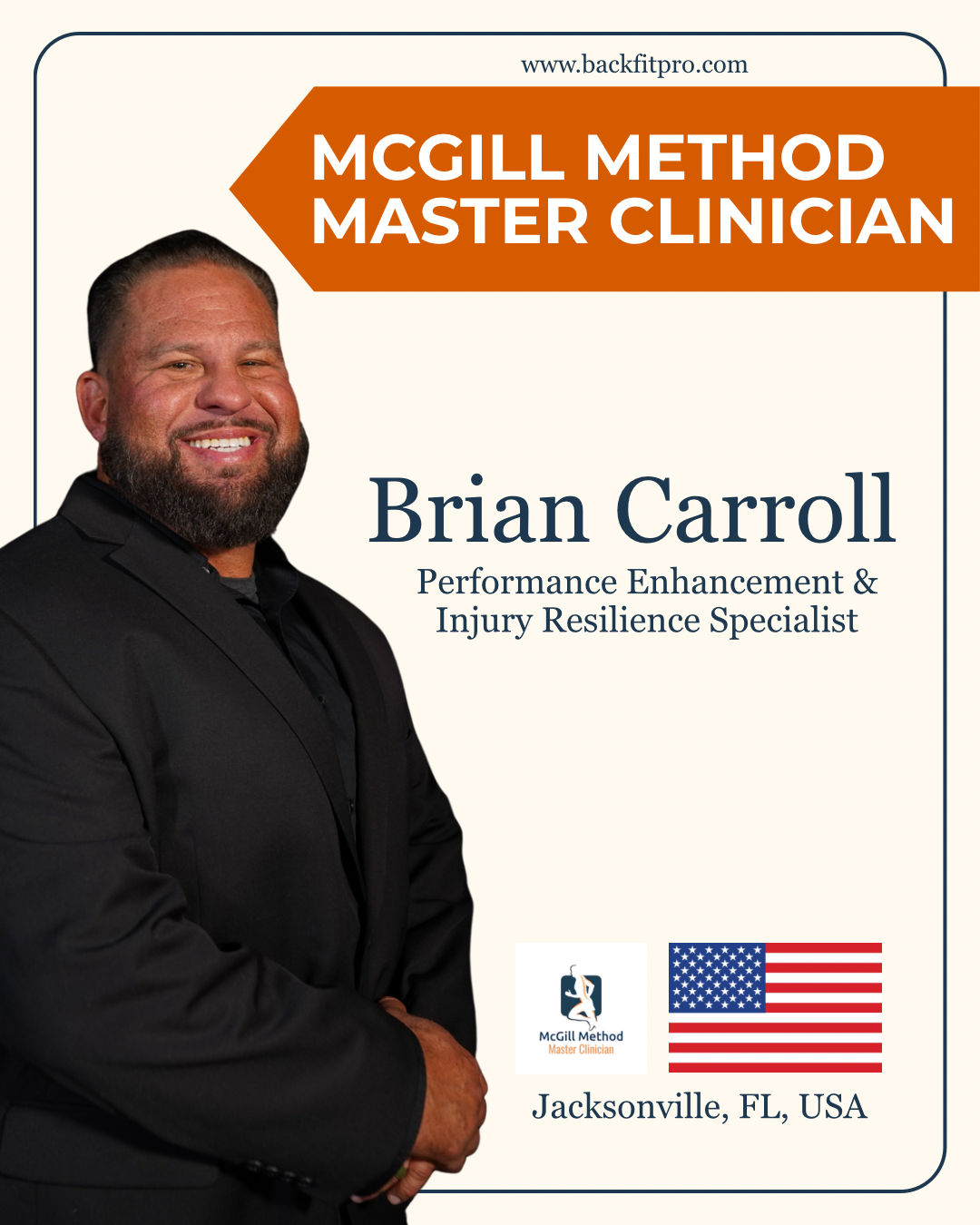
16 Dec Becoming A McGill Method Master Clinician
Becoming A McGill Method Master Clinician: What This Designation Truly Represents
A few weeks ago, I officially earned the designation of McGill Method Master Clinician. This represents the highest level of clinical competency within the McGill Method and carries significant responsibility. It’s not a title given lightly, and it’s not something earned through coursework alone. It reflects trust, experience, and the ability to handle the most complex spine cases that exist.
To understand why this matters, it’s important to clarify what separates a Master Clinician from other levels within the McGill Method system.
Master Clinician vs. Certified Practitioner
The largest distinction between a Master Clinician and a Certified McGill Method Practitioner lies in scope and clinical responsibility.
A Certified Practitioner has completed McGill Method coursework and passed the knowledge competency exams. This demonstrates an understanding of foundational spine biomechanics, basic pain mechanisms, and the general principles of assessment and movement hygiene. While this level of training is valuable, it represents an introductory competency rather than full clinical autonomy with complex cases.
A Master Clinician, by contrast, has been personally vetted and approved by Professor Stuart McGill to assess and manage the most complicated back pain mechanisms. This includes cases involving long-standing pain histories, failed interventions, multi-structure involvement, and highly sensitive or unstable spines. This designation signifies full confidence in one’s ability to identify the true cause of pain and guide the individual toward a durable, pain-free foundation.
A Rare Designation With Global Standards
There are currently only about 14 Master Clinicians worldwide, and I am the only Master Clinician in the Southeastern United States. The nearest others are located in the Northeast and Midwest. This level of scarcity reflects the rigor of the process and the standard required to achieve it.
I often describe this milestone as earning a black belt in the McGill Method. It represents years of mentorship, assessment refinement, and direct clinical experience under Professor McGill’s guidance. It’s not about accumulating credentials—it’s about demonstrating consistent, high-level decision-making when outcomes truly matter.
Integrating Lifting, Coaching, and Clinical Precision
My background as a world-record-holding powerlifter, coach, and consultant plays a significant role in how I apply the McGill Method. I don’t view clinical assessment and performance training as separate worlds. Instead, I integrate them.
The McGill Method provides the framework to identify the pain mechanism, remove the cause of pain, and rebuild capacity safely. From there, my coaching and training experience allows me to take individuals further—helping them return not just to daily function, but to meaningful performance when appropriate. This integration is where long-term success is created.
What a Proper McGill Assessment Actually Does
A true McGill Method assessment is designed to identify specific pain triggers with a high degree of accuracy—often in more than 90% of cases. Once those triggers are identified, the individual is guided to temporarily avoid them, allowing pain sensitivity to decrease.
From there, a targeted exercise plan is introduced to build a pain-free foundation for movement. This is not a generic exercise sheet or a one-size-fits-all program. It is a precise intervention based on the individual’s unique presentation, history, and tolerance.
At the Master Clinician level, this process extends further into MRI interpretation, differential diagnosis between cervical, thoracic, and lumbar involvement, and understanding how adjacent joints—such as the hips and knees—factor into the problem.
Managing Complex and Inflammatory Cases
In recent years, I’ve worked with an increasing number of cases involving systemic or inflammatory contributors that complicate spine healing. Conditions such as Lyme disease, mold exposure, mast cell activation, and other inflammatory disorders can significantly alter how the spine responds to stress and recovery.
Being able to recognize these patterns, interpret imaging accurately, and adjust the strategy accordingly is a critical part of advanced clinical work. This level of decision-making comes from years of exposure to complex cases and ongoing mentorship.
Gratitude, Mentorship, and What Comes Next
I owe a great deal of gratitude to Professor Stuart McGill for his mentorship, corrections, and unwavering standards. Having the opportunity to assess dozens of patients alongside him has elevated my understanding of spine biomechanics, neurodynamics, and both the central and peripheral nervous systems. Additional influence from leaders such as Mike Shacklock has further refined how I approach nerve-related pain and movement tolerance.
Becoming a Master Clinician has been a lifetime goal. I am proud to be one of the few individuals to achieve this designation without holding a PhD or MD—joining a very small group of professionals who worked their way up through experience, precision, and relentless attention to detail.
This milestone is not an endpoint. It’s a commitment to continue helping people with the most difficult cases reclaim their lives through clarity, precision, and intelligent movement.





Sorry, the comment form is closed at this time.