



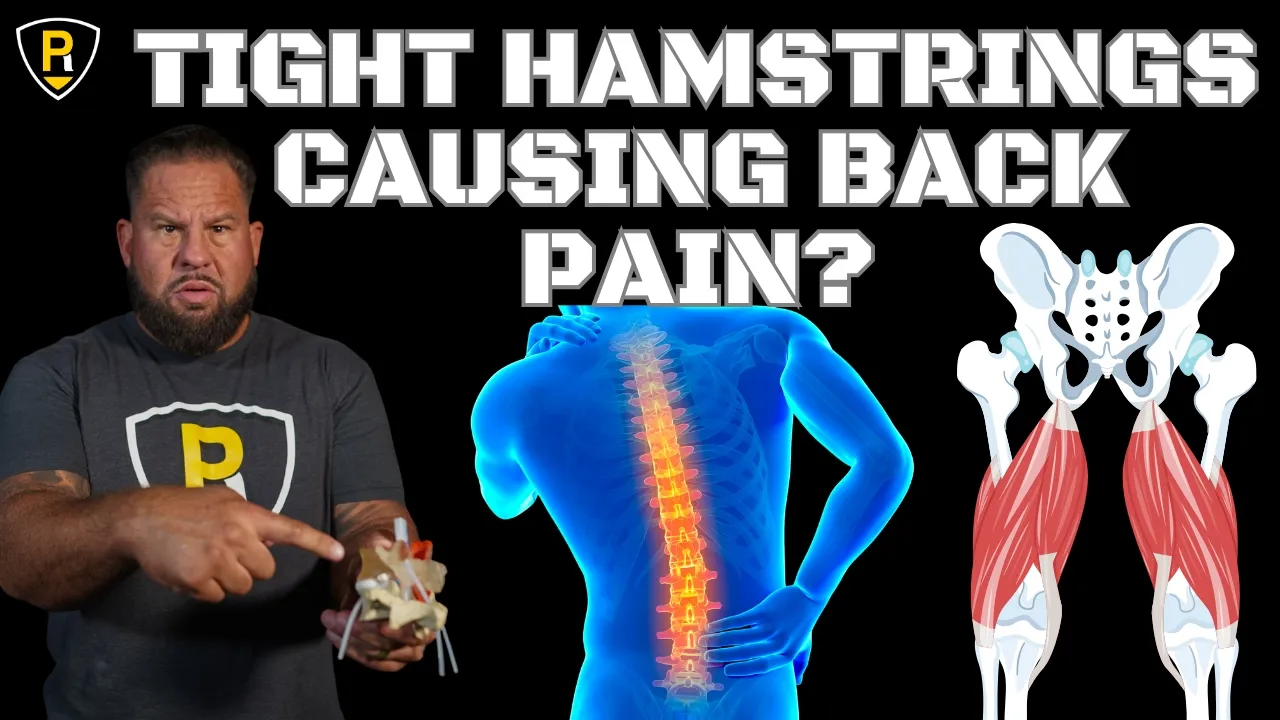
13 Mar Are Tight Hamstrings Really Causing Your Back Pain?
Watch the full video on Rumble!
Article Rundown
- Tight hamstrings are often neurological tension, not true muscle tightness.
- Stretching the hamstrings can increase nerve irritation and worsen back pain.
- Many people need spinal stability, not more flexibility.
- Fix the spine and movement patterns, and the hamstring tightness often disappears.
Are Tight Hamstrings Really Causing Your Back Pain?
Many people believe the same thing: “My hamstrings are tight, so I need to stretch them.” If your low back hurts, the common explanation becomes even simpler—tight hamstrings must be pulling on the pelvis and causing the pain.
So you stretch every day. But the hamstrings never loosen up. The back pain never improves. Sometimes it even gets worse. If that sounds familiar, you’re not crazy—you may simply be treating the wrong problem. In many cases, what feels like tight hamstrings isn’t actually a hamstring problem at all.
Tight Doesn’t Always Mean Short
When most people say their hamstrings are tight, what they really mean is that the back of the leg feels restricted, burning, or pulled during movement. But that sensation doesn’t automatically mean the muscle is shortened or needs to be stretched.
At my clinic, I often see people with “tight hamstrings” who actually have normal hamstring length. During testing, their straight-leg raise may easily go past 90 or even 100 degrees. The muscle itself isn’t restricted. But the moment we add tension to the sciatic nerve tract, everything changes.
Suddenly, the patient feels the exact sensation they describe during stretching—tightness, burning, or pulling through the hamstring, calf, or even into the foot. This follows the neurological pathways of the S1 and S2 dermatomes, which run through the back of the leg. The muscle didn’t change. What changed was the tension on the nerve. That’s the difference between true muscular tightness and neurologically driven tightness.
Why Stretching Can Make Things Worse
If the sensation is coming from the nerve instead of the muscle, aggressive hamstring stretching can actually make the problem worse.
Stretching the hamstring increases tension on the sciatic nerve, which is essentially pulling on the cable that connects the lower back to the leg. If the source of irritation is in the lumbar spine—often around L5 or S1—that stretch simply increases stress on the system. You’re not fixing the cause. You’re just pulling harder on the symptom.
For people who are flexion-intolerant, this can be even more problematic. Many hamstring stretches involve bending forward, which posteriorly tilts the pelvis and increases lumbar flexion. That movement increases pressure on the back of the disc and can irritate the nerve roots even further. The result? The hamstrings feel tight again, almost immediately—sometimes tighter than before.
Not Everyone Needs More Flexibility
Another common mistake is assuming everyone needs more flexibility. That depends entirely on the individual. A powerlifter, sprinter, or explosive athlete may actually benefit from a certain amount of stiffness in the posterior chain. That stiffness contributes to force production and athletic performance.
On the other end of the spectrum are individuals who are hypermobile. These people already have excessive motion in the spine, pelvis, or hips. When they stretch aggressively, they reduce the protective stiffness that stabilizes their joints. Instead of improving their condition, they create more instability. Instability is a powerful generator of pain.
For these individuals, the solution isn’t more stretching—it’s learning to build stability and control.
When the Spine Is the Real Driver
One of the most common oversimplifications in rehab is the statement: “Your hamstrings are tight, and that’s causing your back pain.” In reality, the relationship is often reversed.
An irritated spine can create neurological symptoms that radiate into the hamstrings, producing the sensation of tightness. When the spine settles down, and the nerve irritation decreases, the hamstring tightness often disappears—without stretching. That’s why proper assessment matters.
Sometimes an MRI looks relatively normal, yet the person still experiences symptoms because of instability, movement patterns, or loading intolerance that don’t always show up on imaging. The body is complex, and assumptions rarely solve the problem.
A Smarter Approach
If you’ve been stretching your hamstrings daily and nothing has changed, it may be time to take a different approach. Instead of chasing the symptom, start asking better questions:
- Is this true muscular tightness or neurological tension?
- Does the sensation worsen when the spine flexes?
- Could the issue be coming from the lumbar spine instead of the hamstrings?
Often, the first step is surprisingly simple: stop aggravating the system. Walking, improving spine hygiene, and allowing irritated tissues to settle can often reduce the neurological tension that creates the feeling of tight hamstrings in the first place. Sometimes the smartest move in rehab is not doing more—it’s removing the cause of irritation and letting the body calm down.
The Takeaway
If tight hamstrings were truly the problem, they would respond to stretching. If they don’t loosen up—and your back pain doesn’t improve—there’s a good chance you’re stretching a symptom of something happening upstream, often in the spine. Stop chasing the back of your legs. Start by addressing the system that controls them. Because in rehab and performance alike, precision always beats assumption.



Sorry, the comment form is closed at this time.