



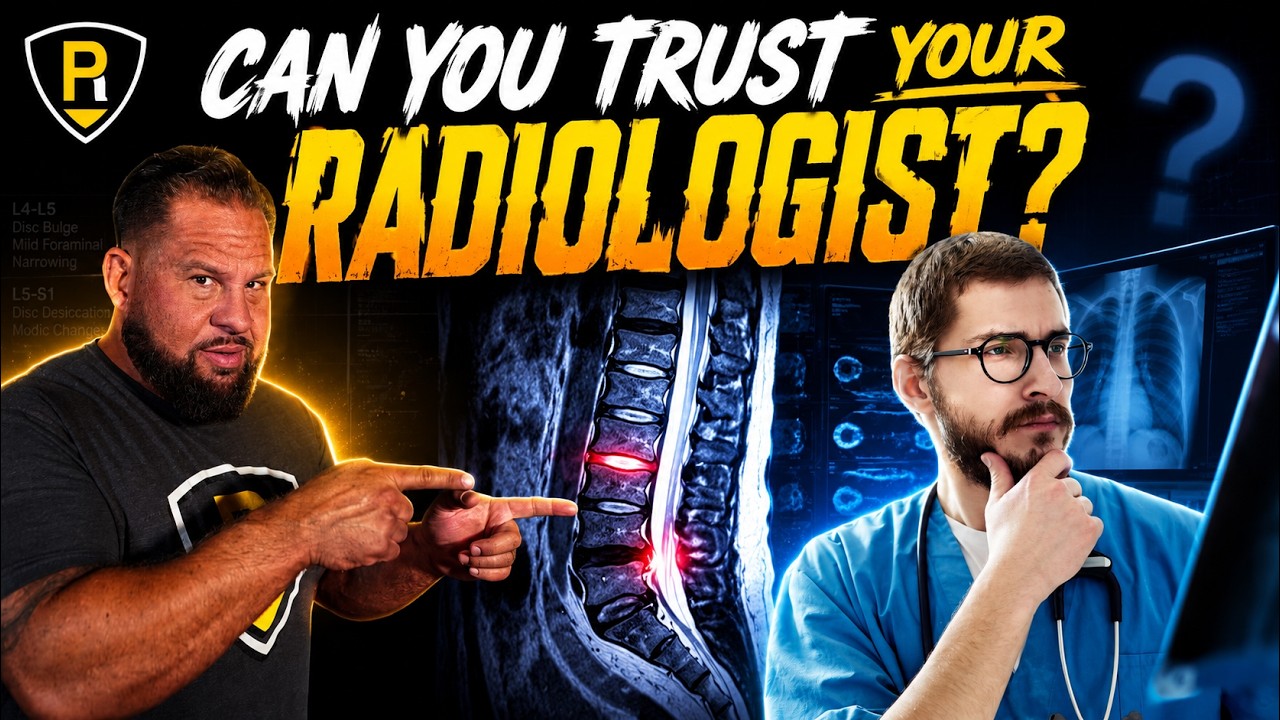
15 Jul Can You Trust Your Radiologist – or the Radiology Report?
Article Rundown
- Radiology reports are only one piece of the puzzle.
- Static images do not show how the spine responds under load.
- “Minimal” findings can still align with significant pain.
- Symptoms, history, and assessment matter most.
Can You Trust Your Radiologist?
Can you trust your radiologist? More specifically, can you trust the radiology report to accurately explain what is causing your pain? That is a loaded question.
I have reviewed hundreds of images over the years. Some radiology reports were excellent. Others missed major findings, overemphasized abnormalities that had nothing to do with the person’s symptoms, or failed to mention the painful area entirely.
That does not mean radiologists are incompetent or that radiology reports are useless. It means the report is only one piece of a much larger puzzle.
What a Radiologist Actually Does
Radiologists are highly trained imaging specialists. They spend years learning how to identify anatomy, fractures, degeneration, disc changes, nerve encroachment, inflammation, tumors, and other structural abnormalities. However, they are generally reviewing images of someone lying still inside a scanner.
They are not watching that person bend, twist, brace, walk, squat, lift, or move into the exact positions that trigger their pain. They may only receive a brief clinical note, and sometimes that note does not provide enough context or directs their attention toward the wrong area. A radiologist interprets anatomy through a static image. They are not conducting a complete movement assessment or taking a detailed history from the patient. That distinction matters.
The Report Is an Educated Opinion
A radiology report is an educated interpretation of what appears on the images. It may describe a finding as “minimal,” “tiny,” “mild,” or “unremarkable.” Those words describe how the structure looks while the person is stationary. They do not necessarily tell us what happens when that spine is loaded, flexed, extended, twisted, compressed, or repeatedly stressed throughout the day.
A small disc bulge may cause no symptoms in one person. In someone else, a seemingly minor finding may line up perfectly with a specific pain pattern and become much more problematic under load.
This becomes especially important with workplace injuries. A report may describe the findings as minimal, and that language may then be interpreted to mean the person should not be experiencing significant pain. That is not always an accurate conclusion.
Images Must Be Matched to the Person
People often send me their radiology reports and ask what I think. The truth is, I do not think much about the report until I understand the person. Where is the pain? What triggers it? What relieves it? Does it radiate or centralize? Is it a dull, bony ache, a burning sensation, or sharp nerve pain? Does sitting make it worse? Does standing help? Does bending, loading, or twisting reproduce the symptoms?
Only after collecting that information can we begin looking at specific spinal levels and comparing the symptoms with the images. The goal is to determine whether there is a one-to-one relationship between what we see and what the person experiences. Sometimes the imaging does not show much, yet the person has significant pain. That does not mean the pain is imaginary.
Other times, the spine looks completely beat up on imaging, yet the person reports only mild discomfort. The area may have stiffened, adapted, or settled down over time, even though it still looks rough structurally. Imaging and pain do not always correlate perfectly.
Do Not Let the MRI Become the Boogeyman
The MRI report should not become the boogeyman. A scary-sounding report can convince someone that they are permanently damaged, even when their symptoms are manageable and improving. On the other side, words such as “minimal” or “unremarkable” can make someone feel dismissed when they are dealing with severe, life-altering pain.
The most important information comes from the person’s symptoms, history, triggers, movement patterns, and assessment. The report may be helpful. The images may be helpful. But neither should be interpreted without context.
The Report Is Only One Piece of the Puzzle
This is not an attack on radiologists. There are excellent radiologists who provide detailed, thoughtful reports and clearly explain what they see. However, I have also seen reports that were completely disconnected from the person’s symptoms and the images themselves. I have seen major areas of concern minimized, overlooked, or left out entirely.
That is why you cannot rely on one sentence from a radiology report to explain everything happening in a painful spine. The report matters. The images matter more. The assessment and symptom history matter most.



Sorry, the comment form is closed at this time.