



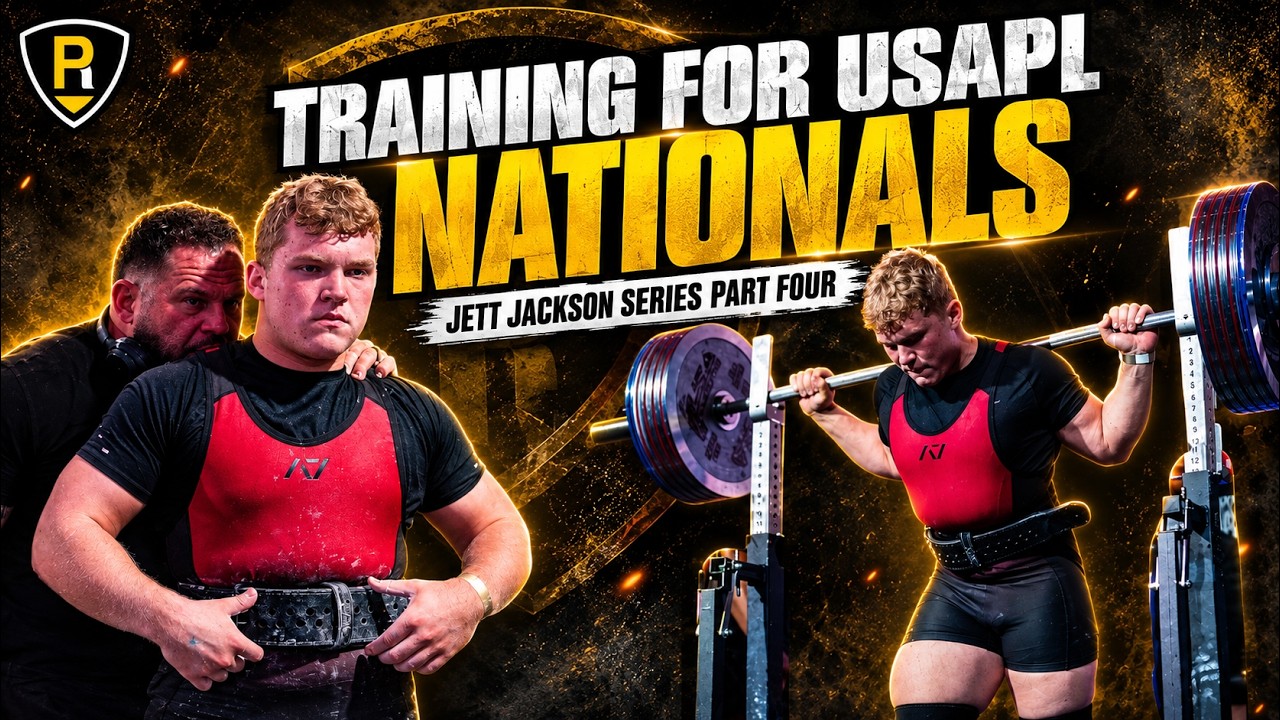
19 Aug Jett Jackson Series Part 4: How We Peaked a 17-Year-Old for USA Nationals in Six Weeks
Article Rundown
- Peaked Jett for USA Nationals in just six weeks
- Cut volume while increasing intensity and precision
- Prioritized confidence, recovery, and explosive bar speed
- Kept nutrition and bodyweight high to support performance
Six Weeks to Nationals
Coming out of Part 3, Jett had already made significant progress. He was sitting right around 220 pounds, had filled out through his shoulders, traps, glutes, and legs, and was doing about 85% of the core work I had assigned him. For a 17-year-old, I will take that. I usually gave him a little more than I expected him to complete anyway, so if he got most of it done, we were right where we needed to be.
Then things changed quickly. Jett had competed through his high school weightlifting season, and along the way they slipped into a USAPL meet in Mississippi and got him qualified for USA Nationals with token attempts. By the time they came back to see me, we had roughly six weeks to figure out how to peak his squat, bench, and deadlift without completely running him into the ground.
Working Backward From the Goal
At this point, we were not trying to build a bunch of new strength. The foundation had already been laid. I wrote down some realistic goals, roughly a 575 squat, a bench in the 350 range, and around a 529 deadlift, and then we worked backward from there.
The training became very low volume with the intensity gradually climbing. Everything centered around precise singles, perfect execution, and building confidence under heavier weights. We needed to maintain and sharpen the bench after months of competition, bring the squat and deadlift into a peak together, and most importantly, get him to Nationals fresh, explosive, and recovered.
The Weekly Peaking Split
The structure was simple. Early in the week we had his primary squat and deadlift day. Wednesday was his heavy competition bench day. Friday became a speed-focused squat and deadlift session, and Sunday was speed bench.
I normally would not have a lifter deadlift twice per week this close to a meet, but Jett lacked confidence in the deadlift. The second exposure was intentionally light. We used roughly 50 to 60 percent for fast singles with short rest periods. The goal was not fatigue. It was repetition, technique, intent, and giving him more opportunities to feel comfortable pulling from the floor.
The speed bench work served a similar purpose. After competing so often through the high school season, we needed to rebuild some confidence and explosiveness without constantly grinding heavy weights.
The Non-Negotiables Stayed
Even during a peak, the foundational work did not disappear. The McGill Big Three stayed in. His shoulder Big Three stayed in. Thoracic mobility stayed in. His weak-point work stayed in where appropriate. I also stayed on him about walking tall, sitting tall, and moving like an athlete instead of moving like a sloth.
And yes, every once in a while Jett would get a little sassy with me. When that happened, I had my own methods of correcting the situation. A quick bear hug and carrying him around the gym usually fixed the attitude pretty quickly.
Fueling the Peak
One mistake Jett made coming out of the state meet was assuming that because the training volume had dropped, his calories needed to drop too. He ended up weighing around 211 instead of the 220 pounds we wanted.
That is exactly what I did not want heading into Nationals. The USAPL uses a two-hour weigh-in, so there was no reason to unnecessarily drain him before competing. I wanted him eating aggressively, recovering aggressively, and maintaining his bodyweight around 220. A lower-volume training phase does not mean you suddenly stop fueling performance. The entire point of the peak is to shed fatigue while maintaining the strength you already built.
Turning the Intensity Up
During the first portion of the peak, we used work around 80 percent on the competition lifts. Squats and deadlifts were performed with an emphasis on perfect setup, bracing, and explosive execution. Bench followed the same approach with competition pauses and consistent setup. We kept some assistance work like pause squats, lunges, leg curls, close-grip benching, rows, carries, shrugs, and stir-the-pots, but that work gradually decreased as Nationals approached.
From there we moved toward singles around 90 percent. As those moved well, the assistance work continued to fall away. During the final heavy week, Jett worked into roughly 92 to 95 percent for a few singles on the competition lifts. He squatted in the low 500s and pulled around 500 pounds.
The goal was confidence, not fatigue. I wanted him handling enough weight to know he was ready, while always leaving something in reserve.
Meet Week Is About Recovery
Once the final heavy sessions were finished, the work was done. Jett came in during meet week and touched a couple of light weights on the squat and deadlift simply to stay sharp and reinforce confidence. Nothing more.
Meet week is not where you get stronger. It is where you finally allow the fatigue accumulated over months of training to disappear. Walking, the McGill Big Three, shoulder work, thoracic mobility, light movement, good posture, consistent bodyweight, aggressive eating, and aggressive sleep were the priorities. No hard conditioning. No testing. No unnecessary heavy lifting. And absolutely no last-minute heavy session because you suddenly feel like you need to prove something.
Bar speed is king. Confidence is king. The volume from the previous months built the strength. The peak simply gave Jett an opportunity to reveal it. In the final part of this series, I will take you through meet day itself, our attempt strategy, how Jett performed, and how everything we built from August 2025 through June 2026 came together in his first true powerlifting meet at 17 years old.



Sorry, the comment form is closed at this time.