



12 Dec When the Bar Still Feels Heavy: Lessons From a Podcast With MOPs and MOEs
Article Rundown
- Empty bars don’t feel light — stability makes them manageable.
- Coaching and assessment are “jazz,” responding in real time.
- Brian rebuilt his spine after being told to retire.
- The comeback relied on patience, core endurance, and smart overload.
When the Bar Still Feels Heavy
During my conversation with the MOPs and MOEs crew, a simple question came up that lifters have asked me for years: “At what point does the 45-pound bar feel like a PVC pipe?”
My answer was quick: we don’t use those. Not the 45, not the PVC. When you live in the world I lived in for two decades, you’re pulling the 65-pound squat bar from the rack. But the deeper point is this: the empty bar never magically becomes light. It feels only as stable as you are. If your spine is unstable, if your core isn’t coordinated, then 45 pounds may as well be 400.
People imagine that once you become a world-class lifter, warmups must float. They don’t. The bar feels exactly like the bar — what changes is your ability to manage it with a body that’s been trained to do one thing exceptionally well: create stiffness on demand.
Coaching Isn’t a Script — It’s Jazz
On the podcast, I explained something that surprises a lot of people: when someone comes to work with me, I rarely know exactly what the session will look like. That’s not ignorance — that’s experience.
Assessment and coaching at a high level is jazz. You respond to what’s in front of you. A client presents their pain triggers, movement habits, injury mechanisms, and I throw back the next logical stimulus. They respond; I adjust. Back and forth, a rhythm, a conversation through movement.
Sometimes that jazz leads to immediate relief — shifting a disc just enough to take tension off a nerve root that’s been screaming for years. Other times it’s simply teaching someone how to stiffen their core properly for the first time in their life. You’d be shocked how many intelligent, hard-working lifters have never once learned how to lock in the spine. When they finally do, the light bulb goes off, and the rest of the assessment becomes a different world.
This jazz concept is something Dr. Stuart McGill and I have talked about for years. It’s the art inside the science.
From Baseball to Powerlifting Obsession
During the podcast, I shared more of my background because context matters. I started lifting seriously in 1999 after high school. I had talent in baseball, but I never applied myself the way I could have. When I found lifting — and especially that first bench meet in ’99 — I poured everything into it for the next 21 years.
My career was simple: head down, one mission. And that mission ended in 2020 with the biggest squat of all time — 1,306 pounds — done pain-free. I achieved the milestone as a 300-pound lifter, not a 500-pound superheavyweight like the man who held the record before me. That matters because it underscores one core principle: engineering the body can beat sheer mass if you understand how to build a spine capable of bearing immense load.
The same principles that rebuilt my broken back in 2013 later became the foundation for the squat that broke the all-time record.
Rock Bottom: When Doctors Told Me I Was Finished
Before that comeback, I was done. Multiple world records in multiple weight classes, world titles — and then my back collapsed under me. A split sacrum, heavily damaged discs, nerve irritation, and fractures. Doctors wanted to fuse me. Others told me to simply stop lifting. Most didn’t even bother with an assessment.
Then I found McGill.
He looked me straight in the eye and said, “If you were my son, I’d tell you to retire.” And he had every reason to say it. But he also said something else: “I can probably get you pain-free. But I won’t promise you a return to heavy lifting.”
I pushed back. I wanted my record back. I wasn’t done.
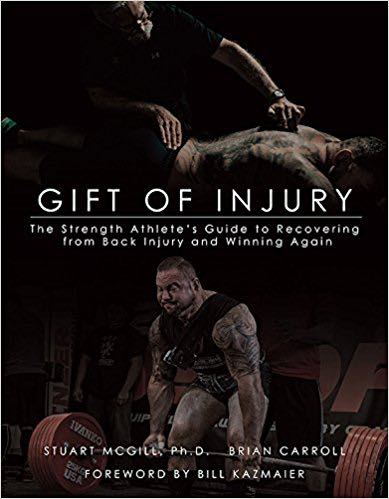
And that began our own jazz session — the volley that eventually led to us writing Gift of Injury together. He told me to get pain-free first. Then maybe we’d see. Eighteen months later, I was pain-free…and hungry.
What the Rebuild Actually Looked Like
On the podcast, the guys asked what really happened during those 18 months — behind the scenes, not the Instagram version. Truth is, every movement hurt. Sitting, standing, walking, crawling — everything was a pain trigger. Lifting wasn’t even on the table.
So I desensitized. I walked. I learned to move without provoking symptoms. I trained core endurance — not old-school “abs,” but the deep, coordinated trunk muscles from the pelvis to the lats and pecs and everything in between.
Planks, variations of the Big Three, carries, stir-the-pot, and goblet squats. As pain reduced, I added small, intentional exposures to load. Light barbells. Then quarters. Then staggered increases every few weeks. No ego. No shortcuts.
Here’s the part lifters hate hearing: bones aren’t muscles. They heal on their own timeline — much longer than it takes muscles to heal. That’s why I advocate in 10/20/Life to deload in your training every 3-4 weeks.
Eventually, I learned the real difference between having enough strength to lift a weight and having enough capacity to survive a meet day. I built that, too — by losing unnecessary bodyweight, mimicking meet demands, and respecting recovery like my life depended on it.
Because, truth be told, it did.
The Unsexy Truth Behind My Comeback
People want to believe I used some secret protocol, or exotic supplements, or cutting-edge therapies. I didn’t. No growth hormone. No BPC-157. No TB-500. No magic.
Just progressive overload, smart movement, hard-earned discipline, and the willingness to stay out of the pain cycle long enough for tissue to truly adapt.
And eventually, that led to the biggest squat of all time and a pain-free spine — two things the medical world told me I’d never see again.
Buy Gift of Injury!
Buy Back Mechanic!
Buy Ultimate Back!


Sorry, the comment form is closed at this time.