



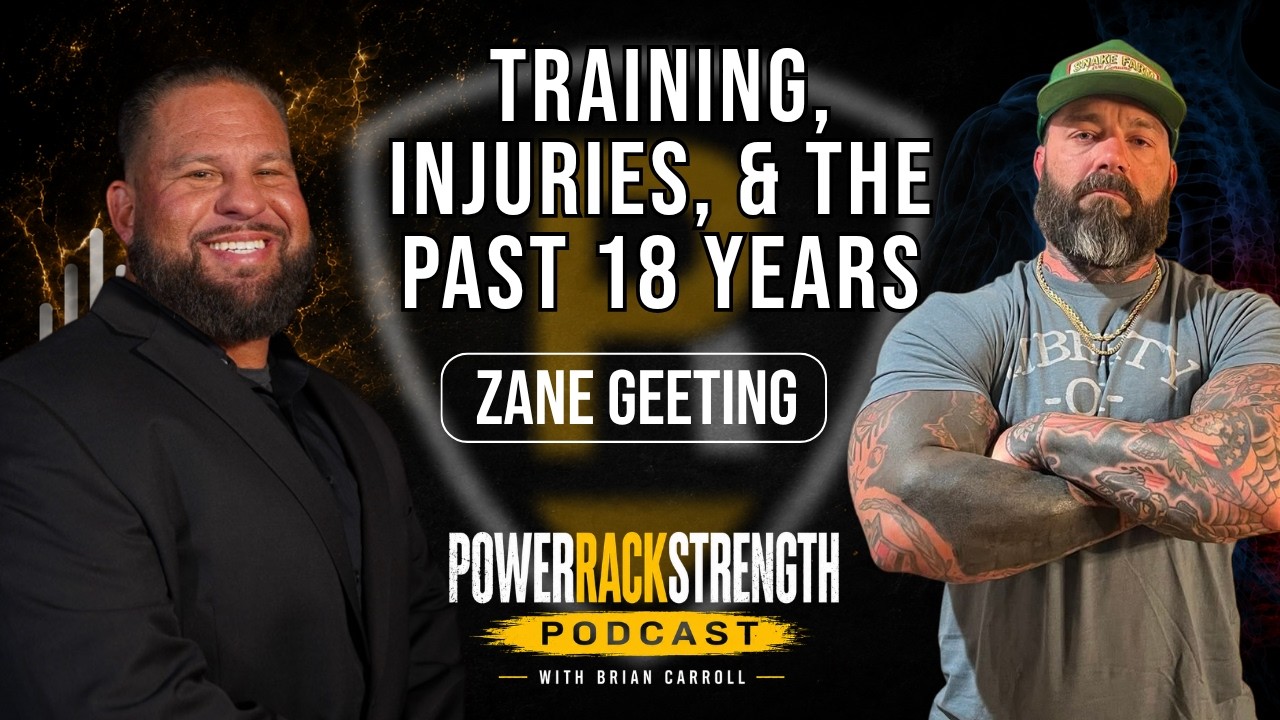
14 Aug From My First Online Client to a Lifelong Friend: Training, Injuries and 18 Years With Zane Geeting
Article Rundown
- Zane was one of my first online coaching clients and added nearly 180 pounds to his total.
- Our early powerlifting years helped shape the training principles I still use today.
- Injuries forced Zane to adapt his training without giving up strength or competition.
- Nearly two decades later, the coaching relationship has turned into a lifelong friendship.
Where It All Started
Zane Geeting and I go all the way back to around 2008, and he holds a pretty unique place in my coaching history. He was essentially my first online client. This was before online coaching became what it is today, and at the time, I was still experimenting with a lot of the principles that would eventually become part of how I coach and program today. Zane would send me videos; I would evaluate what I was seeing, adjust the training, and we figured a lot of this stuff out together.
The results came quickly. Within roughly six to nine months, Zane added around 180 pounds to his total and eventually broke the 2,100-pound mark. What started as a coach and athlete relationship eventually became much more than that. We became teammates, traveled together, competed around the same circles, and over the years he became one of my best friends.
The Powerlifting Years
When Zane and I started working together, powerlifting was a different world. Some of my favorite memories come from those underground training sessions between roughly 2010 and 2014. We would have multiple monolifts going at once, with rooms full of legitimately world-class lifters handling enormous weights. The intensity was something that is difficult to explain unless you were there.
Zane remembers those years the same way. It wasn’t just about the numbers. It was the environment, the people, the different perspectives, and the experience of being surrounded by lifters who were pushing one another at an extremely high level. Looking back, those were some special years, and you don’t always realize how special something is while you’re living through it.
Training Has to Evolve With the Athlete
One of the biggest themes of our conversation was something I’ve preached for years: there is no magic program. People are constantly looking for the newest split, exercise or training system when the fundamentals are usually much simpler. Build a sound program, use the least effective dose necessary to create progress, identify the weak points and attack them.
What makes Zane interesting is that he has continued applying those principles long after stepping away from competitive powerlifting. After more than two decades in the sport, he’s now competing in arm wrestling, but the foundation of his strength training hasn’t disappeared. He still uses variations of the squat, bench, and deadlift, waves volume and intensity, manages fatigue, and builds general strength. The specific exercises have changed because the goal has changed. That’s exactly how training should work. The principles stay relatively constant, while the application changes based on the athlete.
Injuries Change the Plan, Not Necessarily the Goal
Zane also dealt with a significant pec injury during his powerlifting career. After consulting multiple specialists, he ultimately decided to rehab what he had instead of immediately pursuing a complicated surgical option. The injury affected his bench permanently, but it didn’t end his ability to train or compete.
This is another important point. Your injury history has to influence your exercise selection. An exercise can be great on paper and still be completely wrong for a particular athlete. You have to look at what the person is trying to accomplish, what they can tolerate, where their weaknesses are and what their injury history allows. That’s why I always come back to assessment. Training should never be cookie-cutter.
Control What You Can Control
Genetics matter. Injury history matters. Structure matters. There are things about your body that you cannot change. But there are also a tremendous number of variables that you can control through intelligent training, recovery, nutrition, and adaptation. Zane is still competing despite years of heavy lifting and multiple injuries because he has learned how to adjust instead of stubbornly forcing his body to do what it did 15 years ago.
The same philosophy applies outside the gym. Zane runs a dealership, operates a 40-acre farm, and still trains and competes. Earlier in his life, his answer was simply to work more and sleep less. Eventually he realized that wasn’t sustainable. He had to build better systems, create efficiencies, and decide where his time actually needed to go. That’s maturation. You stop trying to win by doing everything harder and start figuring out how to do the right things better.
Almost Two Decades Later
The coolest part of sitting down with Zane wasn’t any one lifting story. It’s looking back at where everything started and seeing where we both ended up. He was one of my first experiments with distance coaching. Nearly two decades later, he’s still applying many of those same principles to completely different goals. We’ve gone from coach and athlete to teammates, to close friends whose families vacation together. Training brought us together, but that’s only a small part of why the friendship lasted. After this conversation, it’s pretty obvious we’re going to need a part two.


Sorry, the comment form is closed at this time.