



08 Oct My Take on the Knees Over Toes Approach to Back Pain
Watch the full video on Rumble!
Article Rundown
- Back extensions can be a valuable tool for building posterior-chain strength, but they are not a universal fix for back pain.
- Sitting and spinal flexion are not automatically harmful. What matters is whether a position actually reproduces symptoms for the individual.
- True trunk stability requires more than strengthening the lower back. The anterior, lateral, and posterior core all need to be considered.
- The biggest limitation of a one-size-fits-all Knees Over Toes approach is specificity. Back pain should be assessed based on the person, the pain trigger, and the demands they need to return to.
My Take on the Knees Over Toes Approach
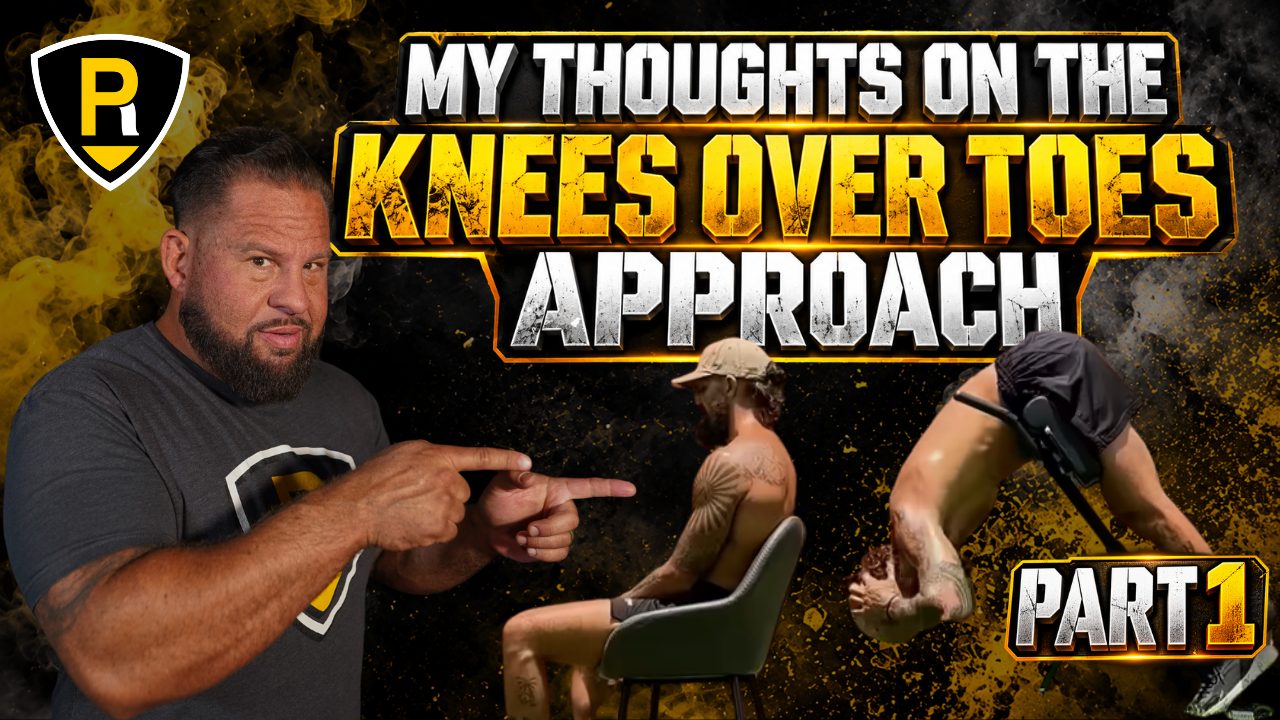
The Knees Over Toes training philosophy has become incredibly popular, and there are plenty of people who have had positive experiences using exercises associated with that system. In this case, I was sent a Knees Over Toes Guy video discussing back extensions, posture, posterior-chain development, and recovering from a lower-back issue.
There are parts of the approach that I agree with. Back extensions can absolutely be useful, and progressively developing strength is generally a good thing. My concern is when broad statements about sitting, posture, weak backs, and back pain start getting applied universally.
There is a big difference between finding an exercise that helped your back and proving that exercise is what everyone needs for a healthy back.
Sitting Is Not Automatically Making Your Back Weak
Early in the Knees Over Toes video, the idea is presented that sitting stiffens the hips and makes the back weaker. I think we need to be much more careful with that statement.
Being sedentary for long periods is obviously not ideal for overall health. Moving regularly, exercising, and changing positions throughout the day are good ideas. But simply sitting down, or occasionally sitting with the spine flexed, does not automatically weaken or damage your back.
The important question is whether a particular position reproduces symptoms in a particular person. Someone with a flexion-sensitive back problem may feel terrible after sitting slumped for an extended period. Someone else may tolerate it perfectly well. Another person may actually struggle more with prolonged standing or extension. That is why context matters.
“Back Pain” Is Not Specific Enough
One of my biggest concerns when discussing back pain is how quickly everything gets lumped into one category. Imagine going to a doctor with abdominal pain and being told simply that you have “stomach pain.” That does not tell us whether you are dealing with a hernia, an appendix problem, a gastrointestinal issue, or something entirely different. Those problems would not all be treated the same way.
The back deserves the same level of specificity. We need to determine what movements provoke symptoms, what positions provide relief, what structures may be involved, and what the person actually needs to return to doing. Saying somebody has a weak back, tight back, bad posture, or good posture without additional context does not give us enough information to build an intelligent plan.
Where Knees Over Toes Back Extensions Can Fit
To be clear, I do not have a problem with the back extension itself. Depending on the person and the reason it is being used, it can be an excellent training tool. Personally, I often prefer a controlled or isometric variation rather than repeatedly moving through large amounts of spinal flexion and extension. That does not mean dynamic repetitions are automatically wrong. Exercise selection needs to match the individual.
The Knees Over Toes approach shown in the video progressively builds capacity in the movement, starting with easier variations and eventually adding repetitions, resistance, and unilateral work. That progression can certainly build strength and work capacity in the posterior chain. The back extension heavily involves the spinal extensors, glutes, and hamstrings. Those muscles matter, but they are only one part of the system.
Your Core Is More Than Your Lower Back
One place where I think the conversation becomes too narrow is when posterior-chain development starts being discussed almost interchangeably with total back or trunk resilience. The trunk works three-dimensionally.
You have the musculature along the back of the spine, but you also have the rectus abdominis, transverse abdominis, internal and external obliques, lats, glutes, hip musculature, and other tissues contributing to stability. That is why I prefer thinking about the trunk or core as an integrated cylinder rather than simply asking whether somebody has a “strong lower back.”
Back extensions may improve posterior-chain strength, but they do not automatically address the anterior and lateral portions of the trunk to the same degree. If the goal is comprehensive trunk stability, the entire system needs consideration.
Adults Are Not Toddlers
The Knees Over Toes video also compares adult movement capabilities to the natural extension and movement seen in children. I would be careful with that comparison.
An infant or toddler has dramatically different body proportions, developing joints, different tissue characteristics, and completely different physical demands than a 55- or 65-year-old adult. Older adults may also be dealing with osteoporosis, osteopenia, previous injuries, degenerative changes, or decades of accumulated loading history. The goal should not be to make every adult move exactly like a three-year-old.
The goal should be to develop the physical qualities that person needs for their own life and activities.
Train for the Actual Demand
The person featured in the video originally irritated his back while performing a backflip. That immediately gives us more useful information. A backflip requires significant force production, trunk control, coordination, mobility, and the ability to tolerate rapid loading. If backflips are something you want to perform, your body should be appropriately prepared for those demands.
After the injury, he began consistently training back extensions and became significantly better at them. He progressed from roughly 10 difficult bodyweight repetitions to much higher repetitions, added resistance, and improved his single-leg performance. That is legitimate progress.
His back also improved during that period, and the back-extension progression may very well have contributed to that improvement. Where I disagree is making the jump from one person’s successful experience to the idea that the same progression solves the underlying problem for everyone.
The Missing Piece Is Specificity
This is where my main disagreement with the Knees Over Toes presentation comes in. The individual describes experiencing a “twinge” in his lower back, but we never really establish what happened. From there, a relatively generalized training progression is applied to a generalized back complaint.
That may work sometimes. It may even work extremely well. But enthusiasm for an exercise does not replace the assessment. Whether it comes from the Knees Over Toes system or any other training philosophy, we still need to ask the same questions. What causes the person’s pain? What reduces it? What are they trying to return to? Where are their actual limitations? What qualities need to be rebuilt?
Back extensions can absolutely be part of that process. They just should not be mistaken for the entire process.
Buy Gift of Injury!
Buy Back Mechanic!
Buy Ultimate Back!
Buy Back Mechanic!
PRS Bands and Straps!

Sorry, the comment form is closed at this time.