

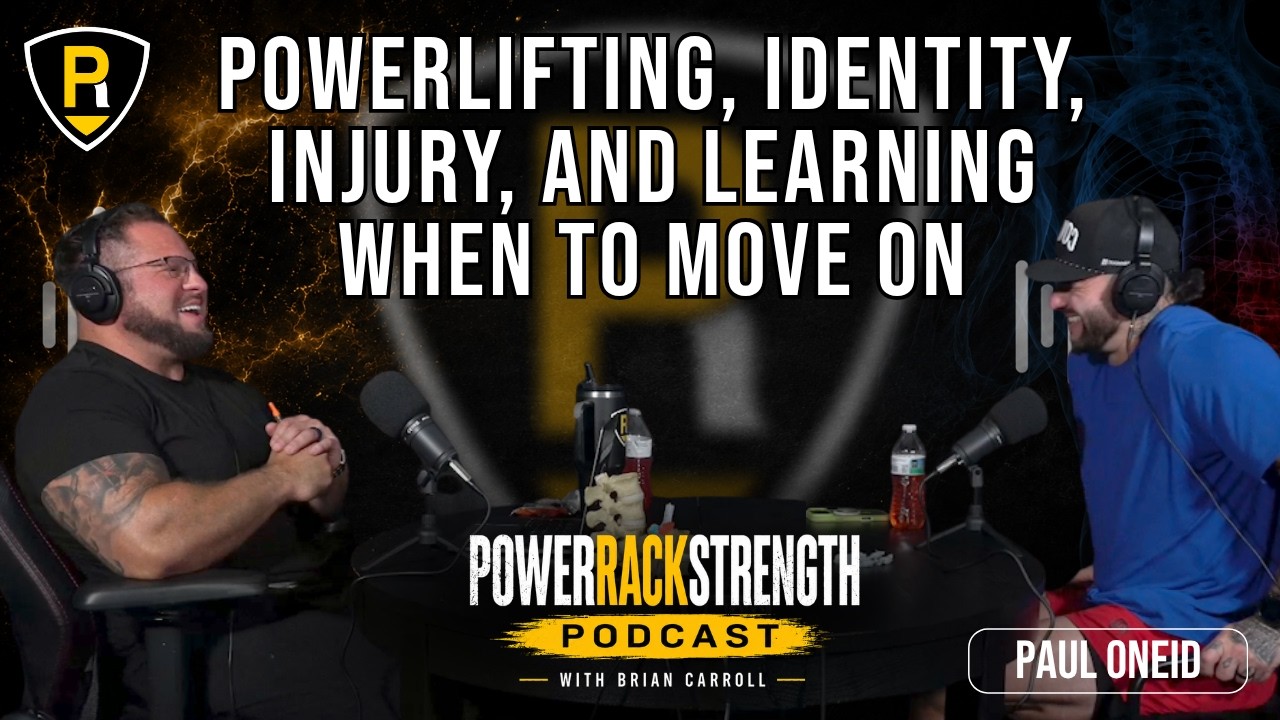
28 Aug Paul Oneid: Powerlifting, Identity, Injury, and Learning When to Move On
Article Rundown
- Paul’s evolution from chasing external validation to living by clearly defined values and priorities.
- How a catastrophic bilateral quad injury tested his identity, mindset, and approach to recovery.
- Why there is a major difference between quitting something and recognizing when you’ve finished that chapter.
- How Paul now applies those lessons to coaching, mentorship, and helping raise the standard for other coaches.
Powerlifting, Identity, Injury, and Learning When to Move On
I’ve known Paul Oneid for more than a decade. We first crossed paths in the powerlifting world around 2014, and over that time I’ve watched him go through about as many different chapters as a person can go through. Powerlifting, collegiate strength coaching, business, divorce, moving across Canada, rebuilding his personal life, bodybuilding, returning to powerlifting, a catastrophic injury, and eventually building something much bigger than just another total on the platform.
That is why I wanted to sit down with Paul. Yes, he is extremely intelligent. He has two master’s degrees, spent years working as a strength coach, was one of my sponsored athletes, and now works extensively with coaches through Master Athletic Performance. But what interested me most about this conversation wasn’t another discussion about sets, reps, or programming. It was how dramatically the person behind all of those things has changed.
When Your Identity Depends on the Total
One of the biggest things Paul admitted was that the younger version of himself lacked awareness. Powerlifting wasn’t simply something he loved doing. A massive part of it became about external validation. If he could total enough, get strong enough, or accomplish enough, maybe that would make him valuable in other people’s eyes.
That is a dangerous position because anything you build completely outside yourself can disappear. The sport can disappear. Your strength can disappear. A relationship can disappear. Your career can change. And if your entire identity is attached to those things, what are you standing on when one of them gets taken away?
Paul eventually started asking himself those questions. Injuries forced some of it. Changes in relationships and careers forced some of it. Therapy, journaling, personal development, and simply getting older helped too. Over time, he started understanding his own values instead of constantly looking outside himself for validation.
Every Yes Is Also a No
One thing Paul said that I thought was excellent was that every time you say yes to something, you are simultaneously saying no to something else.
If you say yes to another two hours at work, maybe you are saying no to two hours with your family. If you say yes to training when something more important needs your attention, you are saying no to that responsibility. There are trade-offs everywhere, whether you acknowledge them or not.
Paul now consciously organizes his priorities around his values. If family truly ranks above training, then training cannot continuously take priority over family. If being physically and mentally healthy allows you to better support your wife, your athletes, or your business, then taking care of yourself has to occupy an appropriate place on that hierarchy too.
That sounds simple, but most people never actually sit down and audit whether their actions match what they claim to value.
When Both Quads Let Go
The athletic side of Paul’s story is just as dramatic. After stepping away from powerlifting and doing a bodybuilding show, he eventually found himself enjoying training again. His hip felt better, he had added a considerable amount of muscle, and the desire to squat returned. He worked his way back into serious strength and even tripled 750 pounds in training.
Then, during a meet, everything went wrong.
Coming out of the bottom of a 750-pound squat, his knees shot forward and both sides failed. He suffered avulsion fractures involving both patellas, with the quad tendons pulling bone away with them. Surgery involved cleaning up the damaged bone and anchoring both quad tendons back down. He went from being an extremely strong, capable man to spending six weeks in locked braces with a hospital bed set up in his office and a commode beside it.
But Paul told me something important about that moment. Mentally, he was okay. Years earlier, an injury like that may have destroyed him because being “Paul the Powerlifter” was too large a part of his identity. This time, powerlifting was something he did. It was not the entirety of who he was.
Make Everything Rehab
Paul’s recovery mentality was exactly what I would expect from him. His words were that he turned every moment he could into rehab.
That doesn’t mean doing something stupid or trying to force healing. It means taking ownership of every controllable part of the process. When you are dealing with a catastrophic injury, there are going to be things you cannot control. You cannot make a surgically repaired tendon magically heal overnight. You cannot skip biological timelines.
But you can control your effort. You can control your consistency. You can control your nutrition, your sleep, your attitude, and whether you actually do what the rehabilitation process requires of you.
That mindset is a big reason why seeing Paul now is so impressive. He didn’t simply get back to walking around normally. He rebuilt himself into someone who can train hard again, squat again, and continue challenging himself physically without needing that challenge to define his entire existence.
Quitting Versus Being Finished
Later in the conversation, we got into something that I think applies far beyond powerlifting. Paul has said before that he “quit” powerlifting. I told him I don’t really think that is what happened.
I think he finished.
There is a difference between walking away because something got hard and recognizing that you got what you needed from a chapter of your life. Paul spent years becoming one hell of a powerlifter. Eventually, the novelty wears off. You are injured, you are clawing for five more pounds, and the thing that once gave you purpose may stop being fun.
For Paul, powerlifting eventually became less about proving something to everyone else and more about using manufactured hardship to become a better version of himself. Once he understood that, he didn’t need the identity anymore. He could take the lessons and move forward.
Raising the Bar Somewhere Else
Today, a huge part of Paul’s focus is coaching and developing other coaches. He and his wife Olivia operate Master Athletic Performance, where they provide training and nutrition coaching, and Paul also works directly on mentorship and education for coaches.
What I like about his approach is that he wants coaches to have somewhere they can ask questions, test ideas, be wrong, learn, and improve without immediately getting torn apart for not already having every answer. The goal is simple: raise the bar. Raise the bar in how coaches work with their clients, and raise the bar in how coaches educate themselves and build their businesses.
That is probably the biggest takeaway from my conversation with Paul. You should continue evolving. The things you value at 25 probably shouldn’t look identical at 35 or 45. Strength is great. Achievement is great. Having something difficult to pursue is great. But eventually, you need to understand why you are doing it.
Paul is still strong. He is still competitive. He is still going to find hard things to do because that is part of who he is. The difference is that now the hard thing serves the man instead of the man serving the hard thing.
Buy Gift of Injury!
Buy Back Mechanic!
Buy Ultimate Back!
Buy 10/20/Life!

PRS Bands and Training Straps!

Sorry, the comment form is closed at this time.