



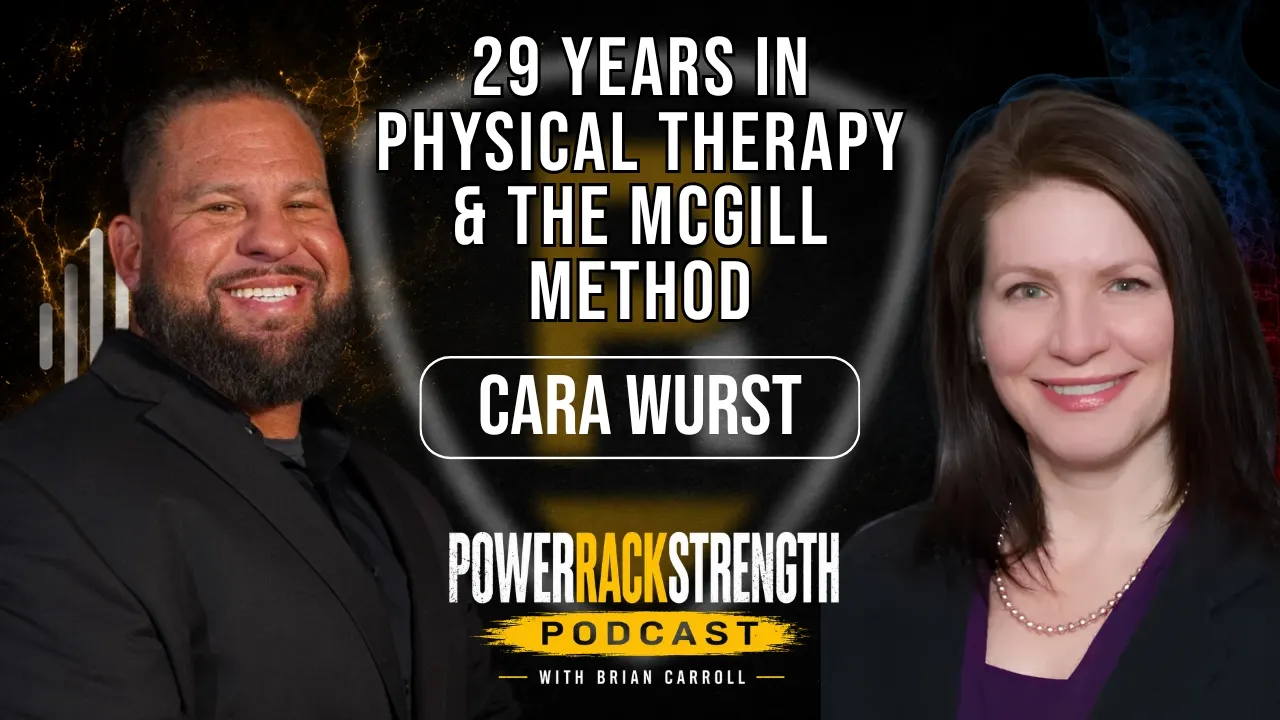
04 Sep Cara Wurst: 29 Years in Physical Therapy and the McGill Method
Article Rundown
- Good spine care starts with identifying the individual pain mechanism, not following a cookie-cutter plan.
- The McGill Method is about assessment, symptom reduction, and rebuilding capacity, not simply avoiding spinal movement.
- Great clinicians know their limits, refer when needed, and keep learning from other experts.
- Experience doesn’t eliminate failure. It teaches you how to use failure to expose weaknesses and improve.
Almost 30 Years in the Clinic and Still Learning
I met Cara Wurst back in 2019 at a Gift of Injury seminar that Stu McGill and I taught in Seattle. At the time, Cara had already spent decades working as a physical therapist, but she was beginning to dig deeper into Stu’s work. She eventually reached out to me and asked whether I thought pursuing the McGill certification was worth it. My answer was yes.
I don’t give that answer to everybody. The education is demanding, and depending on someone’s background, it can require unlearning a lot of what they have been taught about the spine. Cara was different because she had already spent years recognizing some of the holes in conventional physical therapy. McGill’s work didn’t force her to throw everything away. It gave her a framework to connect pieces she had already started putting together herself.
The Gap Between Rehabilitation and Performance
One of the things Cara brought up that I’ve seen repeatedly is the gap between traditional physical therapy education and actual strength and conditioning. She went into PT school assuming she would learn how to truly build people back up, progress strength, and eventually return them to performance. Instead, like many clinicians, she received a broad education designed to make her a generalist. Strength and conditioning was only a small piece of that.
That’s part of why our backgrounds work well together. Cara has almost 30 years of clinical experience. I came from the opposite direction. I spent years learning how to train, compete, coach, and manipulate performance before I really understood the deeper clinical mechanisms underneath what I was doing.
Neither person needs to pretend to know everything. Cara has sent lifters to me when she has gotten them out of pain and prepared them to move forward but knows the next stage of performance isn’t her specialty. I can do the same thing when someone needs expertise outside of my wheelhouse. That’s what a good professional network should look like. You don’t build an empire by pretending you’re the answer to every problem. You build a team of people who are very good at different things.
The McGill Method Isn’t a List of Exercises
One of the dumbest criticisms of Stu’s work is the idea that the “McGill Method” means doing the Big Three, never flexing your spine again, and moving around like a robot for the rest of your life. That isn’t what the McGill method is.
The entire point is to understand the individual standing in front of you. What tissues are involved? What movements increase their symptoms? What positions give them relief? What is their injury history? What do they need to be able to do? Then you remove or reduce the pain triggers, allow the irritated tissues an opportunity to settle down, and progressively rebuild capacity.
Sometimes flexion is exactly what somebody needs. An older patient with stenotic changes, facet overgrowth, or reduced space around a nerve root may actually get relief from positions that open that area. Someone else with a completely different mechanism may need the opposite. There is no universal “good movement” or “bad movement” without context. The assessment determines the intervention.
Stop Treating Every Spine the Same
This is where I believe modern rehabilitation continues to get itself into trouble. We still see cookie-cutter programs applied after significant spine injuries and even after surgery. Someone gets a microdiscectomy, fusion, or another procedure and eventually gets handed a generic progression without enough consideration for what caused the original injury.
Cara made a great point during our conversation: surgery isn’t like replacing a water pump. Twelve weeks pass, and suddenly you don’t just slam your foot on the gas. Tissue tolerance matters. Force management matters. The original injury mechanism matters. The person matters.
The same problem exists on social media when people make blanket claims about adaptation. Yes, the human body adapts. That doesn’t mean every tissue will infinitely adapt to whatever load you throw at it. Every structure has a tipping point, and everybody’s tipping point is different. Your training history, anatomy, previous injuries, occupation, sport, total loading and recovery all influence what you can tolerate.
Experience Teaches You How Much You Don’t Know
One of my favorite parts of this conversation had nothing to do with a particular exercise or back-pain mechanism. It was about becoming better at your craft.
Cara has been a physical therapist for 29 years and still talks about areas where she needs to improve. She specifically mentioned MRI interpretation as something she wants to continue developing before pursuing the next level as a clinician. That mindset matters.
I’ve had the same experiences. Years ago, I was working alongside Stu and thought I was much further along than I actually was. We pulled up an MRI from a difficult case, and I realized I didn’t know what the hell I was looking at. Stu told me there was nothing wrong with being a very good certified practitioner. At the time, that crushed me.
Let Failure Show You Where to Grow
Eventually, it became fuel.
You either let moments like that destroy your ego, or you use them to show you exactly where your weaknesses are. Failure has a way of bringing clarity. It tells you what you don’t know, what you need to work on, and whether you actually want something badly enough to keep going.
That’s one of the biggest reasons I enjoyed this conversation with Cara. After almost three decades in physical therapy, she’s still asking questions, still learning, still refining her approach, and still willing to admit when somebody else is better suited to handle part of a patient’s journey.
That’s what good clinicians do.
They don’t stop learning once they get the letters after their name.
Buy Gift of Injury!
Buy Back Mechanic!
Buy Ultimate Back!
PRS Bands and Training Straps!

Sorry, the comment form is closed at this time.